AI Agents in Enterprise Workflows: What's Actually Working in 2026
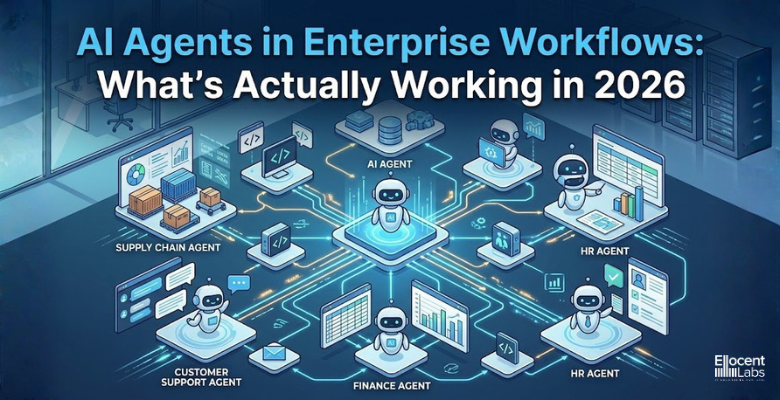
What are AI agents in enterprise workflows? AI agents are autonomous software systems that interpret a business goal, reason through the steps required to achieve it, and take actions across multiple enterprise tools and platforms — without step-by-step human instruction. In 2026, they are being deployed to automate high-volume operational workflows such as invoice processing, employee onboarding, IT ticket resolution, and compliance checks. Unlike chatbots, which respond to queries, AI agents execute end-to-end tasks. Unlike RPA scripts, they adapt to variation and handle unstructured inputs using language model reasoning.
It's Monday morning. A new hire needs system access across five platforms. A procurement manager is waiting on three approvals. IT has a backlog of password resets from Friday. HR just pushed a compliance update that will take two days to cascade through the right people. None of these tasks are technically difficult. Combined, they consume hundreds of hours every month — and every one of them is a candidate for an AI agent.
AI agents for enterprise workflows are no longer a research topic. They are production systems running inside real organisations right now, handling the operational friction that has quietly drained productivity for years. According to Gartner, fewer than 5% of enterprise applications embedded agent capabilities in 2025. By the end of 2026, that figure is projected to hit 40%. That is not a gradual shift — it is an architectural transformation happening in real time.
At Ellocent Labs, we build AI-powered systems for organisations that need them to work in production, not just in a demo. This post covers what is actually happening with AI workflow automation in 2026: where the real returns are, where projects break down, and what it takes to do this properly.
What AI Agents Actually Do in an Enterprise Context
An AI agent in an enterprise context is a software system that interprets a business goal, plans the steps required to achieve it, takes actions across tools and data systems, and adapts when conditions change — all without step-by-step human instruction. It is not a chatbot (which answers questions) and not an RPA script (which follows fixed rules). It is a system built for work that is dynamic, multi-step, and judgment-dependent.
Beyond Chatbots: Agents That Act, Not Just Answer
Most enterprise AI deployments to date have been assistive — tools that surface information, draft responses, or suggest next steps. Agents are different because they execute. An agent can be given a goal like "process this invoice batch, flag anomalies, route approvals, and update the ledger" and work through it autonomously. Where a chatbot stops at the answer, an agent continues through to the outcome.
This distinction matters because it changes the scope of what can be automated. Complex, multi-system workflows that were previously untouchable — because they required context, decision-making, and cross-platform action — are now within reach. The underlying AI models provide the reasoning capacity. The agent architecture provides the execution layer.
The 8-to-12 Application Problem
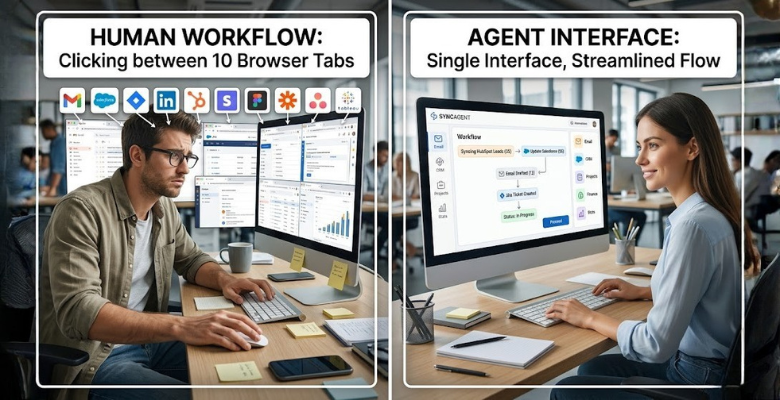
Research into enterprise knowledge work consistently finds that employees navigate between eight and twelve different web applications during a standard workflow. Every context switch has a cost: reorientation time, manual data transfer, and the accumulated cognitive load of maintaining state across disconnected systems. AI agent orchestration addresses this directly. Rather than requiring a human to move data from the CRM to the ERP to the approval system, a well-designed agent handles that entire chain — and does it faster, with an auditable record.
This is where the productivity argument for agentic AI becomes concrete. It is not about replacing human judgment on complex decisions. It is about eliminating the mechanical, high-friction work that surrounds those decisions.
Where AI Agents Are Delivering Real ROI in 2026
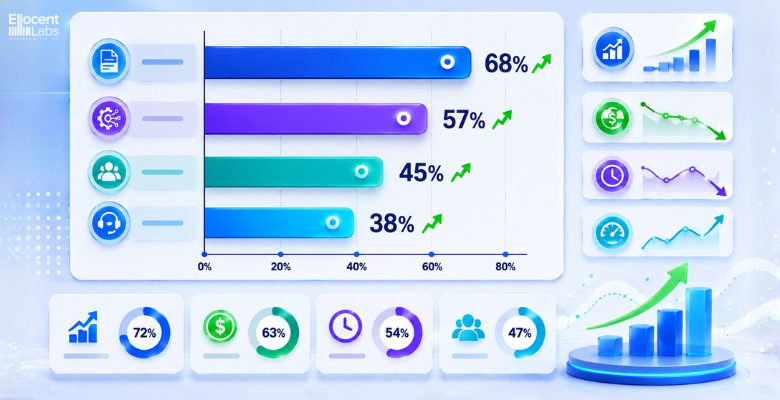
The highest-ROI enterprise AI agent deployments in 2026 are in document processing, IT and HR automation, and customer operations — not customer-facing chatbots. McKinsey data shows organisations implementing agents in these areas report 3–15% revenue growth and 10–20% improvement in sales ROI. The common trait across all top-performing deployments: they target high-volume, rule-driven operational work that previously required armies of specialists.
Document Processing and Compliance
Invoice handling, contract review, purchase order matching, and compliance checks are the breakout use cases of 2026. These workflows are predictable in structure, painful in volume, and expensive when done manually. An AI agent can perform three-way purchase order matching across systems in seconds, flag exceptions for human review, and maintain a full audit trail throughout. McKinsey data indicates that organisations implementing AI agents in these areas report revenue growth of 3–15% and a 10–20% improvement in sales ROI — not because the agent is selling, but because operational efficiency compounds across the business.
IT and HR Workflow Automation
Employee onboarding is a representative example. A typical onboarding process requires coordinated access provisioning across identity management, CRM, ERP, and collaboration platforms — with role-based logic that varies by department, location, and seniority. Done manually, this takes days and creates risk at every handoff. With a multi-agent system handling the orchestration, it can run in minutes, with human oversight at the exception points that actually require a decision.
IT service management follows the same pattern. Ticket triage, password resets, access requests, and system diagnostics all follow structured logic that agents handle reliably — freeing IT teams for work that requires genuine expertise.
Customer Operations
AI agents that handle initial triage, information retrieval, and case routing in customer operations are delivering consistent results in 2026. Average cost per AI interaction sits at $0.25–$0.50 compared to $3–$6 per human interaction, and organisations with mature deployments are handling 70–80% of routine cases without human involvement. The nuance is important: agents handle the high-volume, low-complexity cases well. Edge cases and emotionally sensitive interactions still benefit from human judgment.
Where Agentic AI Projects Fail — And Why
The short answer: most enterprise AI agent projects fail at integration and governance — not at the AI layer itself. Only 25% of AI initiatives deliver expected ROI, and only 16% reach enterprise-wide scale. The technology is not the bottleneck. The architecture and oversight surrounding it are.
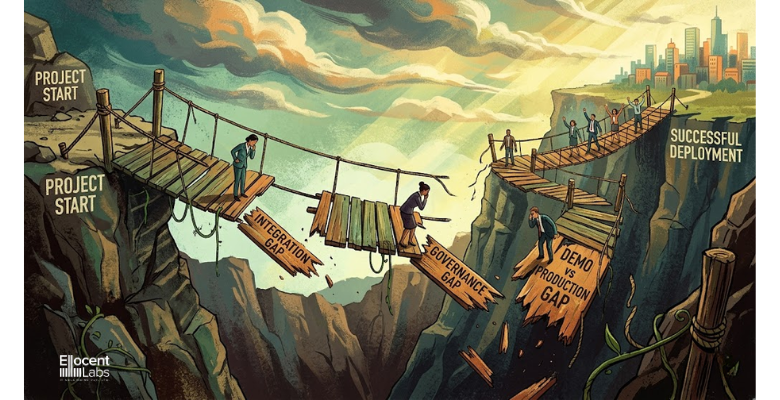
3 Reasons Enterprise AI Agent Projects Stall
The Integration Gap
The majority of failed agent projects share a root cause: integration was an afterthought. Agents derive their value from their ability to act across systems. When the underlying connections are fragile, poorly authenticated, or missing entirely, the agent becomes an expensive dead end. Building durable, secure integrations — with proper API management, authentication, and error handling — is the foundational work that makes agents viable. It is less exciting than the AI layer, and it gets skipped far too often.
The Governance Gap
Deloitte's 2026 research found that only one in five organisations has a mature governance model for autonomous AI agents. That means 80% of enterprises deploying agents are doing so without the oversight infrastructure to manage them safely at scale. This is not an abstract risk. Agents that take actions across systems — sending emails, updating records, processing payments — need defined boundaries, escalation paths, audit logging, and rollback capabilities. Governance is not a constraint on AI agents. It is what allows them to scale.
The "Demo vs Production" Problem
Enterprise AI agent platforms are optimised for demonstrations. They showcase conversational fluency and elegant interfaces. What they rarely expose in a demo is how access control is enforced at the field level, how multi-system failures are handled, or how the system behaves when a downstream API is slow or unavailable. Organisations that evaluate agents based on demo performance consistently underestimate the engineering required to make them production-grade. The delta between "it works in the demo" and "it runs reliably in production" is where most projects stall.
How We Approach AI Agent Development at Ellocent Labs
Ellocent Labs builds AI agents and agentic workflows for enterprises that need production-grade systems — not pilots that prove a concept and then sit in a drawer. Our approach is shaped by the failure modes above, which means we spend as much time on integration architecture and governance as we do on the agent layer itself.
Architecture First, Features Second
Every enterprise AI agent development engagement we take on starts with the same question: what systems does this agent need to act on, and how reliable are those connections? We map the integration surface before we design the agent behaviour. This means identifying the APIs, data schemas, authentication flows, and failure modes up front — so the agent we build has solid ground to stand on. Our custom software development practice provides the integration depth that off-the-shelf agent platforms typically cannot.
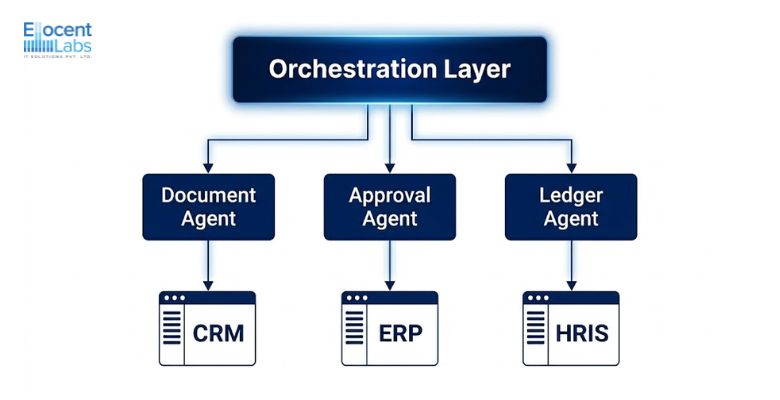
Multi-Agent Orchestration for Complex Workflows
Most enterprise workflows are too complex for a single agent. A purchase-to-pay process, for example, might involve a document processing agent, a validation agent, an approval routing agent, and a ledger update agent — each with a defined scope and clear handoff protocol. Ellocent Labs designs these multi-agent systems with a central orchestration layer that manages dependencies, sequences tasks, and determines where human oversight is required. This architecture is more resilient and easier to audit than monolithic agents attempting to handle everything.
Our AI software development team works across the full stack — from the model layer and tool integrations through to the front-end interfaces that give your team visibility into what the agents are doing and why.
What This Looks Like in Practice
Consider a mid-size manufacturing company running procurement, HR, and finance across three separate platforms with no native integration. Their approvals process required manual handoffs at every stage — a purchase request would sit in someone's inbox for two to three days before it reached the right person, and the resolution time for a routine IT ticket was running at four days on average.
Working with Ellocent Labs, they deployed a set of coordinated AI agents across their workflow surface. The procurement agent handled purchase order ingestion, three-way matching, and exception flagging. The HR agent managed onboarding task sequencing and system access provisioning. An orchestration layer connected them to a central visibility dashboard where operations managers could monitor queue status and intervene where needed.
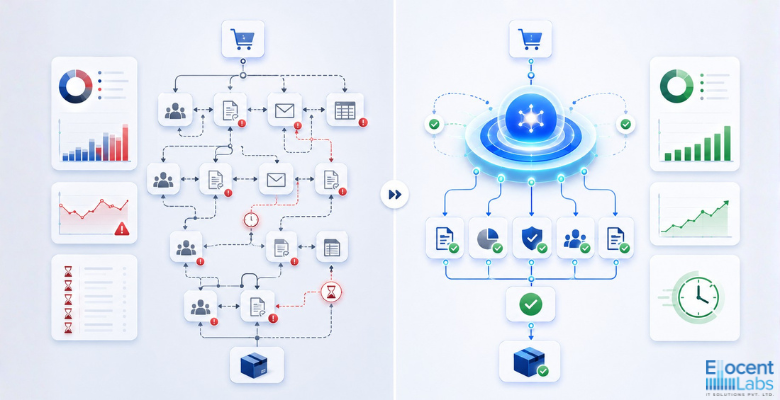
The outcome was not that humans were removed from the process. It was that humans were removed from the parts of the process that didn't require them — and given clear, actionable oversight of the parts that did. Resolution times dropped significantly. More importantly, the operations team could focus on vendor relationships, compliance decisions, and process improvement instead of chasing approvals.
This is what agentic AI looks like when it works: not a technology showcase, but a quiet operational shift that compounds over time.
A Decision Framework: When Should Your Business Deploy AI Agents?
Not every workflow needs an AI agent. Here is a practical framework for knowing when to deploy, when to prepare first, and when to hold off entirely.
4 Signs Your Business Is Ready to Deploy AI Agents Now
- The workflow is high-volume and rule-driven. Invoice processing, access provisioning, IT ticket triage, and report generation are the ideal starting points. The logic is consistent, the volume justifies the investment, and ROI is straightforward to measure. If your team performs the same multi-step task dozens of times per week, that task belongs on an AI agent.
- The workflow crosses multiple systems. If completing a single process requires your team to manually move data between three or more platforms, an agent with proper integrations will eliminate that friction entirely. The more systems involved, the stronger the ROI case.
- You have clean, structured data. Agents perform best when their inputs are reliable. Poor data quality does not make agents fail gracefully — it makes them fail confidently. If data hygiene is an issue, resolve it before deploying an agent on top of it.
- Human oversight can be embedded at defined checkpoints. The best agentic workflows are not fully autonomous. They run within defined boundaries and escalate exceptions to a human decision-maker. If you can define those boundaries clearly — what the agent does, what it escalates, and what it never touches — you can deploy safely.
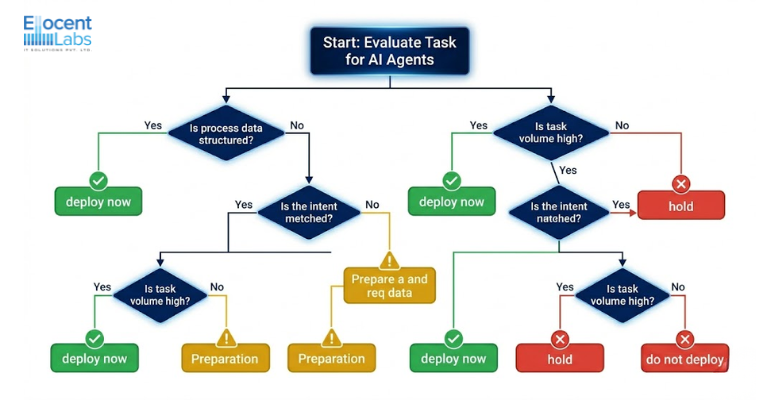
4 Signs You Should Prepare First Before Deploying
- The process is poorly documented or inconsistent across teams. An agent can only follow a process that exists. If three people in your organisation do the same task three different ways, standardise the process before automating it.
- You cannot define what "correct" output looks like. Agents need a success condition. If your team cannot agree on what a good outcome looks like for a given workflow, an agent cannot be measured — and an unmeasured agent becomes a liability.
- Integration access to relevant systems is unavailable or unreliable. Agent value is proportional to integration depth. If key systems lack APIs, have outdated authentication, or are being replaced in the next six months, wait until the integration surface is stable.
- Governance and audit requirements are unclear. Before deploying agents that take actions across business systems, define the boundaries: what the agent is permitted to do autonomously, what requires human approval, how decisions are logged, and how errors are rolled back. Governance is not a constraint on AI agents — it is what allows them to scale.
The Single Most Important Insight on AI Agent ROI
The organisations seeing 5x–10x returns from AI agents are not the ones who moved fastest. They are the ones who started with the right workflows, built durable integrations, and established governance before scaling. Speed of deployment is not the variable that determines success. Quality of preparation is.
Frequently Asked Questions
What is an AI agent in an enterprise context?
An enterprise AI agent is an autonomous software system that can interpret a goal, reason about the steps required to achieve it, take actions across business tools and platforms, and adapt its behaviour when conditions change. Unlike a chatbot, which responds to queries, an agent executes multi-step workflows — updating records, routing approvals, processing documents, and orchestrating other systems — without requiring step-by-step human instruction.
How is an AI agent different from RPA (Robotic Process Automation)?
RPA follows fixed, scripted rules. It breaks when the interface or process changes. AI agents use language model reasoning to interpret context and adapt to variation — they can handle unstructured inputs, make conditional decisions, and work across dynamic environments. In practice, the best enterprise deployments often combine both: RPA for highly stable, structured tasks, and AI agents for anything that requires judgment or handles variable inputs.
What does AI agent development cost for an enterprise?
Cost varies significantly based on the number of systems being integrated, the complexity of the workflow logic, and the governance and monitoring infrastructure required. Simple, single-workflow agent deployments can be scoped and delivered in weeks. Multi-agent orchestration across complex enterprise systems is a longer engagement. At Ellocent Labs, we scope each project based on integration surface and workflow complexity — talk to our team for a structured assessment.
How long does it take to deploy an AI agent in production?
A focused, well-scoped agent targeting a single high-volume workflow can reach production in four to eight weeks, assuming integration access is available and the process is documented. Multi-agent systems with broad integration requirements typically take three to six months to reach stable production. The critical path is almost always integration — not the AI layer.
Ready to Build AI Agents That Actually Work?
Most enterprise AI projects stall because the demo looked great and the production reality didn't match it. Ellocent Labs builds AI agent systems that are designed for production from day one — with the integration depth, governance structure, and operational visibility your team needs to scale with confidence.
Talk to our team about your workflow automation goals — and let's build something that runs.
Related Blogs
Schedule a 15-Minutes call
Let’s make things happen and take the first step toward success!
Got Ideas? We’ve Got The Skills.
Let’s Team Up!
Let’s Team Up!
What Happens Next?
We review your request, contact you, and sign an NDA for confidentiality.
We analyze your needs and create a project proposal with scope, team, time, and cost details.
We schedule a meeting to discuss the offer and finalize the details.
The contract is signed, and we start working on your project immediately.