AI Recruitment Platform: How We Built It for a UK Client

Hiring in the UK is broken — and everyone knows it. There are too many resumes in the pile, qualified candidates are being manually screened out, and companies are losing out on quality candidates to their more efficient competitors. The latest LinkedIn 2024 report shows that the average time it takes for a company to hire in the United Kingdom is 41 days, and thousands of dollars are spent by companies without even sending an offer of employment to a candidate.
Our client, a UK-based employment agency providing recruitment services for financial and technology jobs, was facing just such a predicament. Their traditional job hiring cycle wasn't working. They wanted something tailor-made—an AI-powered hiring platform to speed up the whole process, remove human bias, and grow in line with their candidate pipeline.
And so they turned to Ellocent Labs. The rest was one of our most exciting projects ever.
In this blog today, we want to share with you all the details of designing, developing, and deploying our new, complete-stack AI hiring system.
Understanding the Client's Challenge First
Before a single line of code was written, we spent three weeks embedded with the client's team. We've always been a discovery-first agency - because you can't solve a problem until you understand it.
The company had more than 800 job requisitions live at any one time. The recruiters’ job was to spend 60% of their time doing manual work: reviewing resumes, scheduling interviews, following up with emails, and updating spreadsheets that were out of date as soon as they were saved.
During discovery, we identified three main problems:
- Matching people to jobs was completely manual, time-consuming, and highly variable
- There was no connectivity between their existing job boards, emails and databases
- Analytics and reporting were absent or done on a manual basis with Excel files that took hours to produce
What would you like us to create? A machine learning-powered recruiting system, please.
The Tech Stack We Chose and Why
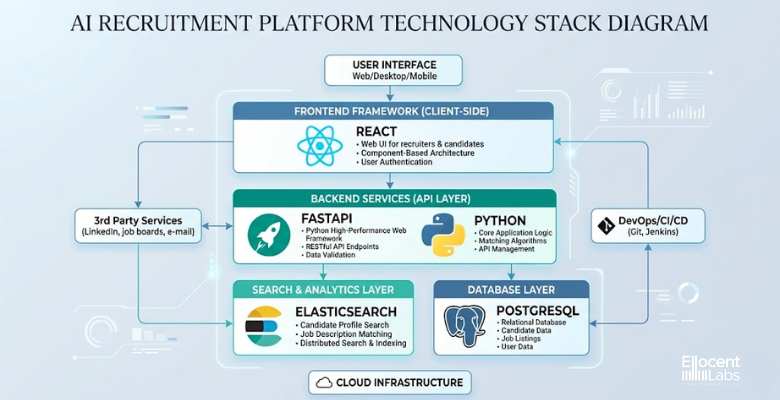
Choosing the right technology stack for a recruitment platform isn't a trivial decision. Not only does it impact the matchmaking and AI capabilities but also the speed at which the system can process thousands of CVs effortlessly.
Here's what we built with and the reasoning behind each choice:
Backend: Python + FastAPI
We chose Python for our AI and machine learning. The ready-to-use packages such as spaCy, scikit-learn and HuggingFace Transformers allowed us to develop, train and experiment with our candidate matching models quickly. FastAPI delivered our REST APIs with asynchronous processing to ensure blazingly fast response times, even with multiple simultaneous users.
Frontend: React.js + Tailwind CSS
Recruiters use dashboards for hours at a time. We wanted the interface to be quick, simple and visually appealing. React provided a component-based approach that allowed us to easily assemble reusable UI pieces, while Tailwind CSS kept our user interface coherent, without having to write an excessive amount of custom CSS.
Database: PostgreSQL + Elasticsearch
Candidate profiles are structured data — PostgreSQL was the right call for relational integrity. But fast, full-text search across hundreds of thousands of CVs? Enter Elasticsearch for near real-time search across multi-faceted candidate data.
AI/ML Layer: Custom NLP + GPT-4 Integration
This was the heart of the platform. We developed a custom NLP engine to convert CVs into structured data - skills, experience, education, even inferred skills. We integrated GPT-4 to understand natural language job descriptions, allowing us to not only search for keywords but also for semantic fit.
Core Features We Built Into the Platform
1. AI-Powered Candidate Matching Engine
The matching engine was the centerpiece of the entire platform. The typical approach to candidate matching is via text search: if your CV includes 'Python,' you show up for a job that mentions 'Python.' But that's a blunt instrument.
We've created a vector-based semantic search engine. A person who has published a paper on "developing scalable microservices in Go" will be found for a 'backend software engineer' position even when those words aren't in the job description. The result? A matched quality rating meant that in the first month after launch, recruiters were able to shortlist 68% faster.
2. Automated Interview Scheduling
Interview scheduling is surprisingly one of the biggest time sinks in recruitment. Back-and-forth emails. Missed calendar slots. Interviewee no-shows due to long process times.
We gave Google Calendar and Outlook API access to a custom scheduling engine, which reads the availability of recruiters, candidates' preferences, and time zone information to make and approve interview appointments. No manual coordination required.
3. ATS Integration & Job Board Sync
The client had an existing Applicant Tracking System (ATS) that they didn't want to replace. So we created a bi-directional integration layer to keep the new platform in sync with the client's ATS by synchronising candidate and application statuses and notes in real time. We also integrated with their job boards (Indeed, Totaljobs, and Reed), so new applications didn't need to be imported.
See how Ellocent Labs approaches third-party API integration across complex enterprise environments.
4. Real-Time Analytics Dashboard
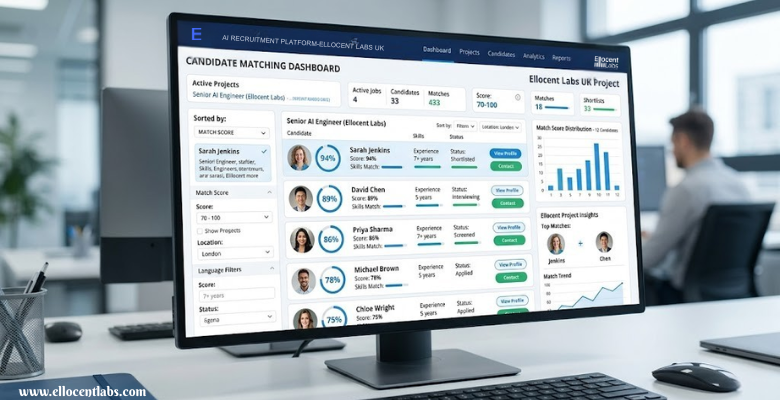
Leadership wanted visibility. Recruiters didn't want to create Excel reports. Our solution to both challenges was a real-time analytics dashboard that captured: time-to-fill by position, candidate drop-off within the recruitment funnel, recruiter activity, and source-of-hire for each job board.
Using Chart.js on the front-end and a data aggregator on PostgreSQL, the dashboard was live with real-time data as events happened on the platform—no page refreshes necessary.
5. Bias Reduction via Anonymised Screening
No doubt hiring decisions are influenced by unconscious bias. Our client wanted to create a more equitable hiring process - so we developed an anonymous mode for screening that masked names, photos, ages, and postcodes of candidates during the initial scoring process. All recruiters would see were skills, experience, and a match score until they selected candidates to shortlist.
How We Approached the Development Process
We broke the project down into five two-week sprints, each with a defined scope, demonstration and feedback cycle that flowed into the following sprint. Our client's head of hiring attended sprint reviews - so the decision-making process was never a secret.
We used Jira for project management, Figma for UI/UX design collaboration, and GitHub Actions for CI/CD pipelines that automatically ran tests before any code was merged into production.
After 14 weeks, we were live - not bad for a complex build like this. We rolled out in a UK staging environment, tested the system in parallel with the client's existing processes for four weeks, and worked out the kinks before switching over to production.
Read more about how Ellocent Labs manages end-to-end software delivery on complex projects.
The Challenges We Had to Solve
No honest case study skips the hard parts. Here are the three biggest challenges we hit during the build — and how we navigated them.
Challenge 1: Messy, Unstructured CV Data
CVs are available in every data format - PDFs, Word, text, even scanned images which do not contain machine-readable text. Our NLP pipeline had to handle all of them. We designed a document ingestion service that used Apache Tika to parse documents and PyMuPDF to extract text from PDFs that sat on top of our NLP engine to produce a clean candidate data model regardless of format.
Challenge 2: GDPR Compliance at Scale
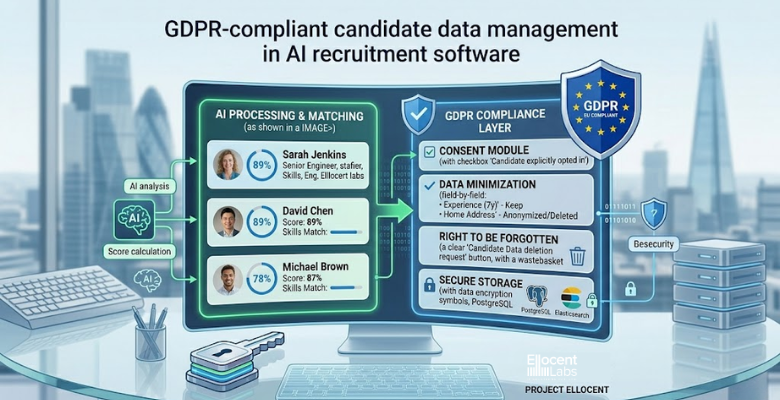
When you're creating a job portal for a UK client, you have to comply with GDPR. All candidate data storage, processing and deletion had to be compliant. We set data retention policies with automated triggers for data to expire, all candidate data was encrypted, and we created a candidate portal for each applicant to edit or delete their data (their right to erasure).
Challenge 3: System Performance Under Load
Recruitment is cyclical. Some weeks are slow and other weeks 2,000 CVs are submitted in 48 hours. We stress tested the platform to handle 3x the load the client expected - and we optimised our queries that ran against Elasticsearch, introduced caching with Redis for commonly accessed candidate profiles and used a job queue (Celery) to process CVs without blocking the main server thread.
The Results: What Changed After Launch
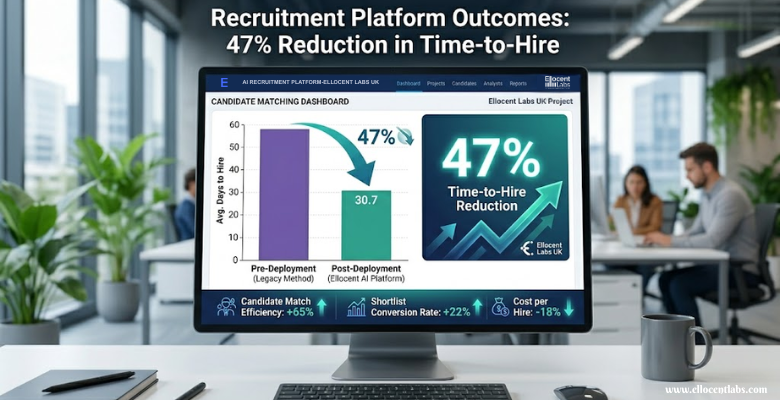
Six months after going live, here's what the data showed:
Beyond the numbers, the shift in recruiter morale was palpable. When we checked in with the team three months post-launch, the consistent feedback was the same: 'We finally feel like we're working with the system, not against it.'
See more client success stories and case studies from Ellocent Labs.
Why UK Businesses Are Turning to AI Recruitment Platforms
A silent revolution is taking place in the UK's hiring sector. In a tight talent market across industries such as technology, financial services, and healthcare, a 40-day recruitment process just cannot afford to be the case. Unfilled jobs are lost productivity, and in tight talent markets, talent is usually snapped up 10 days after becoming available.
AI recruitment platforms address the structural inefficiencies that traditional processes have never been able to solve at scale. It's not a question of speed - it's a question of quality of outcomes, once the noise is removed, better matches are found, and more time is afforded for human recruiters to do what they do best: to build relationships and use their judgement.
The growth in UK companies looking for custom AI recruitment platforms is not a passing phenomenon. It's driven by a market need - and it's growing.
Explore how Ellocent Labs helps UK businesses build custom HR tech solutions tailored to their hiring needs.

What Makes Ellocent Labs Different in This Space
Any number of development agencies can build a CRUD application. Delivering a high-performance AI hiring system that respects GDPR, integrates with existing systems, and actually makes the hiring process better is something else altogether.
What we'd bring to this project is a mix of technical skill in the development of AI/ML solutions, experience in the development and integration of complex B2B SaaS systems, and a consulting ethic that looks at problems, rather than solutions.
Our AI/ML solutions span hiring, finance, health care and logistics - but in every solution, our secret sauce has been the same: we measure success in terms of the value we bring to your business, not the number of features in the final product.
Learn more about Ellocent Labs approach to building enterprise-grade SaaS and software products.
Thinking About Building a Recruitment Platform?
Creating this platform reconnected us to why we do what we do. It was a lot of fun to work on cutting-edge tech: semantic search, natural language processing, real-time APIs, and GDPR-compliant data design. But what made this project meaningful was watching it solve a real problem for real people: recruiters who got their time back, candidates who got a fairer shot, and a business that could scale without hiring ten more coordinators.
If you're an agency, HR department, or talent platform in the UK and you're still using spreadsheets or tools from the last century or doing things by hand, it might be time for a chat.
Ellocent Labs specializes in building custom AI-powered platforms for businesses ready to move faster, hire smarter, and grow with confidence. Explore our AI & software development services or get in touch with our team today — we'd love to hear what you're building.
Related Blogs
Schedule a 15-Minutes call
Let’s make things happen and take the first step toward success!
Got Ideas? We’ve Got The Skills.
Let’s Team Up!
Let’s Team Up!
What Happens Next?
We review your request, contact you, and sign an NDA for confidentiality.
We analyze your needs and create a project proposal with scope, team, time, and cost details.
We schedule a meeting to discuss the offer and finalize the details.
The contract is signed, and we start working on your project immediately.