How to Build Autonomous AI Agents for Enterprise Workflows in 2026
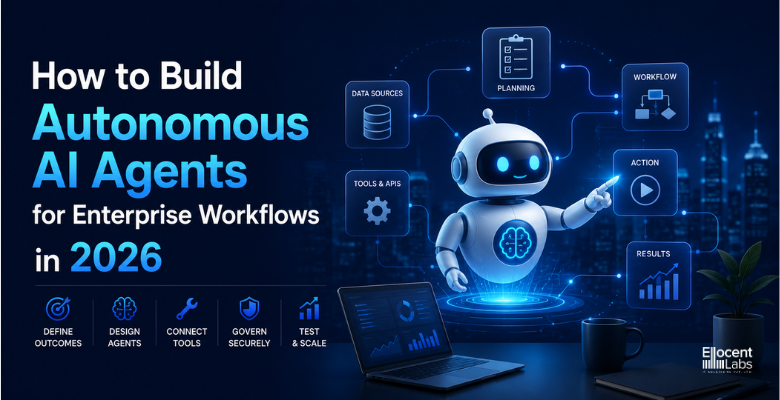
A practitioner's guide to designing, deploying, and governing agentic AI systems that complete real multi-step business tasks—without a human steering every decision.
To build autonomous AI agents for enterprise workflows, you connect a large language model to a set of tools (APIs, databases, code executors), give it a goal, and let it plan, act, and self-correct in a loop until the task is done. The five core components are: goal intake, reasoning engine, tool layer, memory store, and a governance guardrail.
What Exactly Is an Autonomous AI Agent, and Why Does It Matter for Enterprise Teams?
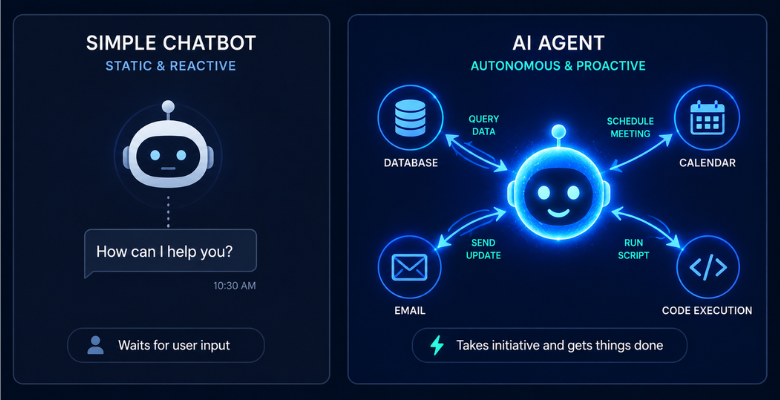
An autonomous AI agent is a software system that receives a high-level goal, breaks it into sub-tasks, selects appropriate tools to execute each sub-task, evaluates the outcome, and loops back to correct itself if something goes wrong—all without a human approving each move. This differs fundamentally from a chatbot (which responds to prompts) or an RPA bot (which follows a fixed script). In enterprise workflows, agents handle tasks spanning multiple systems: pulling data from a CRM, drafting a report, sending it for approval, and updating a project tracker—end to end. As of May 2026, McKinsey estimates that agentic AI can automate or augment up to 60% of knowledge-worker activities across finance, legal, and operations functions.
The shift from chatbot to agent is a shift from reactive to proactive. A chatbot waits for your question. An agent is handed a goal—"reconcile this month's invoices and flag discrepancies above $500"—and works through it autonomously, deciding the next step at every turn. This decision-making loop, technically called a ReAct (Reason + Act) or Plan-and-Execute cycle, is what separates agentic AI from every automation technology that came before it.
At Ellocent Labs, we have tracked this evolution closely. As we detailed in our post on how the industry moved from chatbots to AI agents, the progression was not a sudden leap—it was a steady accumulation of better language models, cheaper compute, and richer tool APIs that finally made autonomous action viable at enterprise scale. Understanding that history matters because it sets realistic expectations for what agents can and cannot do today.
What Are the Five Core Components Every Enterprise AI Agent Needs?
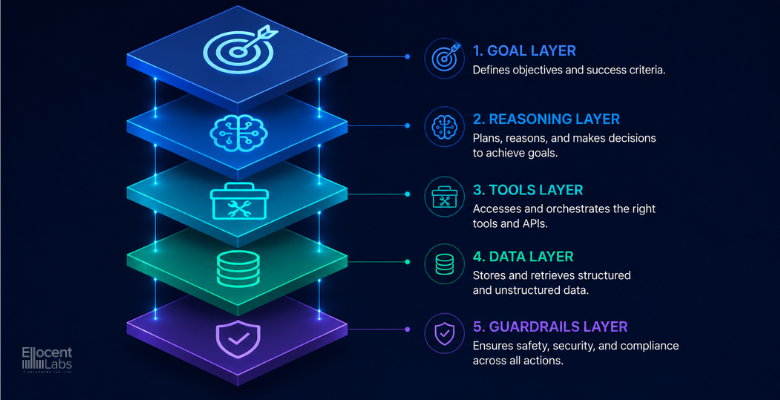
Every production-grade autonomous AI agent for enterprise workflows requires five layers. (1) Goal Intake: a structured interface—API, form, or natural-language prompt—that converts a business request into a machine-readable task specification. (2) Reasoning Engine: an LLM (GPT-4o, Claude 3.7, or Gemini 2.0) that plans, selects tools, and evaluates results. (3) Tool Layer: a registry of callable functions—REST APIs, SQL databases, web browsers, code executors, communication platforms. (4) Memory Store: short-term context in the model's context window plus long-term recall in a vector database (Pinecone, Weaviate). (5) Governance Guardrail: policy rules, permission scopes, and human-in-the-loop checkpoints that prevent the agent from taking irreversible or unauthorized actions. Remove any one layer and the agent either fails silently or creates compliance risk.
-
Goal Intake Layer. Define the task contract clearly before writing code. Ambiguous goals produce agents that spin in reasoning loops. Use structured templates: goal, constraints, success criteria, deadline. This one discipline alone prevents the majority of agentic failures teams experience in production.
-
Reasoning Engine (LLM Core). Match model size to task complexity. Multi-step financial reasoning needs a frontier model. Simple data extraction works fine on a smaller, faster model to control cost. In 2026, model routing—automatically sending tasks to the right-sized model—is a standard architecture pattern. Ellocent Labs implements this routing layer as part of every custom AI software engagement to keep token costs predictable from day one.
-
Tool Layer. Tools are the agent's hands. Start with three to five tools, each with a clean schema. Every tool the agent can call is also an attack surface—expose only what the agent's role requires. This is the principle of least privilege, applied to AI.
-
Governance Guardrail. Every agent touching production data needs a kill switch, a permission scope, and an audit log. Align this layer to the NIST AI Risk Management Framework 1.1 (April 2026) for enterprise compliance coverage.
How Do Traditional Workflows Compare to Agentic Workflows in 2026?
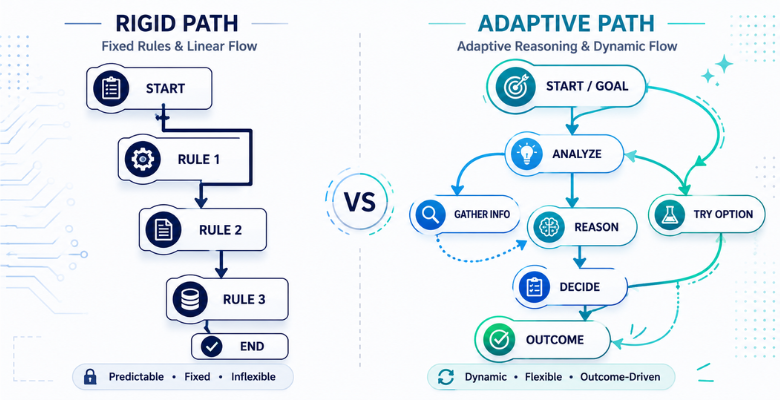
The fundamental difference between a traditional enterprise workflow and an agentic one is who decides the next step. Traditional workflows execute a fixed decision tree written by a developer. Agentic workflows let an LLM reason about the next step at runtime, handling novel situations without code changes. This introduces non-determinism that requires different governance but delivers dramatically faster change cycles and the ability to handle ambiguous, multi-system tasks without bespoke integration work. At Ellocent Labs, our AI-powered automation team uses the comparison below to help clients identify precisely where agentic design adds real ROI versus where a traditional rule-based approach remains the right—and cheaper—tool.
| Dimension | Traditional Workflow | Autonomous AI Agent Workflow |
|---|---|---|
| Decision logic | Hard-coded rules, decision trees | LLM reasons at runtime |
| Handles novel inputs | No — fails or escalates | Yes — reasons through ambiguity |
| Multi-system coordination | Partial — requires custom integration per system | Yes — native tool orchestration |
| Outcome determinism | High — same input, same output | Medium — probabilistic, auditable |
| Time to deploy a change | Days–weeks (code change + QA cycle) | Minutes–hours (prompt + tool update) |
| Cost per run | Low — fixed compute | Variable — LLM token spend |
| Memory across sessions | No — stateless by default | Yes — vector memory store |
| Compliance audit trail | Strong — deterministic logs | Strong if designed for it — not automatic |
| Failure mode | Hard fail, predictable | Soft fail — can hallucinate without guardrails |
| Best suited for | High-volume, repetitive, well-defined tasks |
Complex, variable, multi-step judgment tasks |
Which AI Agent Framework Should Your Team Use in 2026?
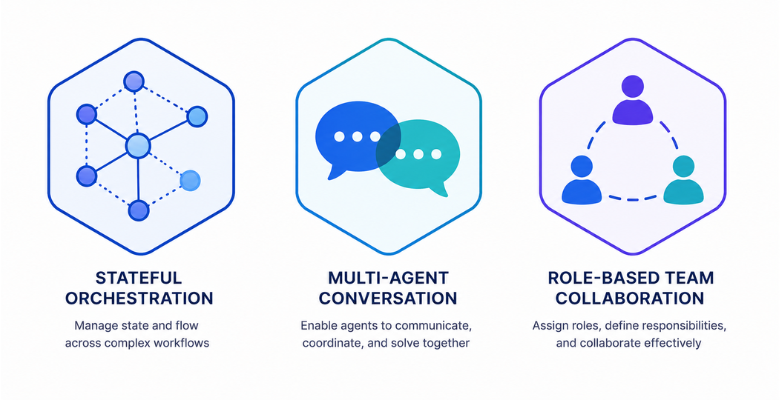
The three production-ready agent frameworks as of May 2026 are LangGraph (LangChain's stateful graph-based orchestration layer, best for long-horizon tasks where partial progress must survive an error), AutoGen (Microsoft Research's multi-agent conversation framework, best for code-generation and analysis pipelines), and CrewAI (role-based multi-agent collaboration, fastest to prototype for agent-team scenarios). All three support tool calling, vector memory, and human-in-the-loop interrupts—the minimum bar for enterprise deployment. The Ellocent Labs engineering team has hands-on production experience across all three as part of our AI software development services.
Framework decision guide
Use LangGraph when your workflows are stateful and long-running—more than 10 steps, or workflows that may be interrupted and resumed. Use AutoGen when the primary use case involves code generation, software QA, or data-analysis pipelines. Use CrewAI when you need a team of specialized agents (researcher, writer, reviewer) collaborating on a single deliverable. For teams preferring managed cloud infrastructure, Google's Agent Builder (updated March 2026) and Azure AI Agent Service significantly reduce DevOps overhead versus self-hosted orchestration.
How Do You Build an Autonomous AI Agent for Enterprise Workflows, Step by Step?
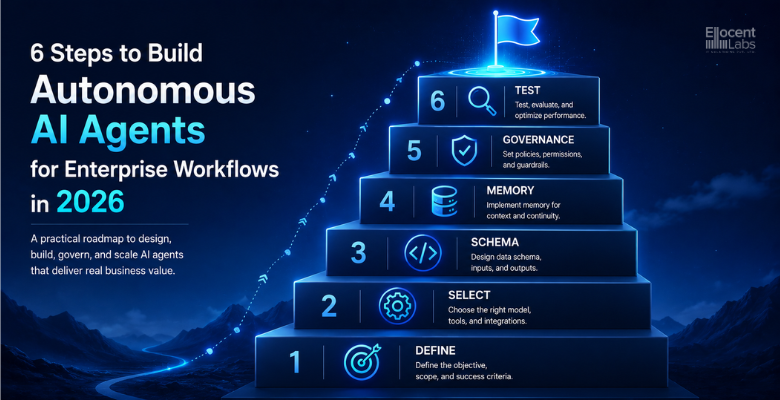
Building an autonomous AI agent for enterprise workflows follows six steps: (1) Define the task boundary—what the agent can and cannot do; (2) Choose your framework—LangGraph, AutoGen, or CrewAI based on task type; (3) Write clean tool schemas—the LLM reads function names and docstrings verbatim to decide when to use each tool; (4) Configure memory—connect a vector store for long-term recall; (5) Implement governance—permission checks, irreversibility filters, and a human-approval interrupt for high-risk actions; (6) Stress-test before shipping—run at least 20 adversarial test cases. A pilot on a single internal workflow (report generation, invoice triage, meeting summaries) surfaces real failure modes before you scale. Ellocent Labs delivers this six-step pilot structure within four weeks as part of our AI-powered automation engagements.
-
Define the task boundary. Write a one-paragraph agent brief covering: the goal, the systems it may access, the actions it is never allowed to take (e.g., sending external email without approval), and the expected format of the final output. This single document prevents the majority of agentic failures before development begins.
-
Select your framework and model. Match model capability to task complexity. Run your eval suite with the smallest model that passes—cost compounds fast at scale.
-
Write tool schemas. Each tool is a typed function with a precise name and description. The LLM uses your description verbatim to decide when to invoke that tool. A vague name like
do_stuff()produces unpredictable agent behavior in production. -
Connect memory. Index your enterprise knowledge base (Confluence, SharePoint, internal wikis) and expose it to the agent as a retrieval tool. This is the difference between an agent that knows your business and one that guesses.
-
Set governance rules. Classify every tool action as reversible (read data, draft a document—runs autonomously) or irreversible (delete a record, trigger a payment, send an email—requires human approval before execution).
-
Evaluate and stress-test. Build an eval suite of at least 20 representative tasks before production. Include edge cases: malformed inputs, missing data, conflicting tool outputs. Track success rate, cost per run, and p95 latency. Ship only after all three metrics pass your internal threshold.
How Do You Keep Autonomous AI Agents Safe and Compliant in a Regulated Enterprise?
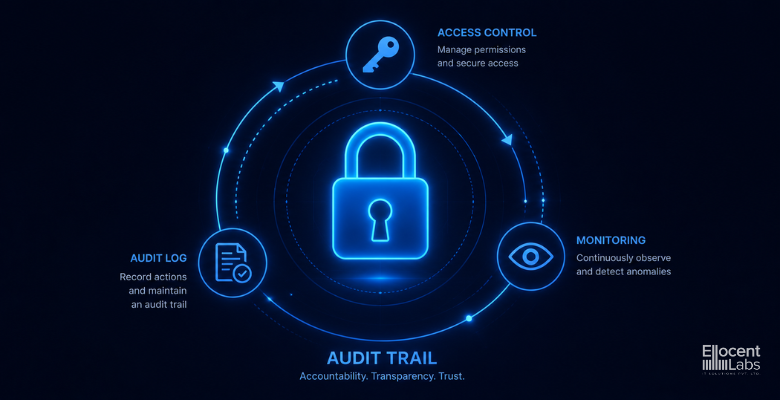
Enterprise AI agent governance in regulated environments rests on four controls. Role-scoped tool permissions: an agent handling HR data must not be able to call a payments API, even if that API exists in the registry—enforce this with permission tokens issued at instantiation. Human-in-the-loop checkpoints for any action that writes to a system of record or triggers external communication. Full audit trails logging every tool call, its inputs, outputs, and the reasoning trace that produced it—shipped to a SIEM (Splunk, Microsoft Sentinel). Policy guardrails aligned to NIST AI RMF 1.1 (released April 2026), which introduced formal risk categories for agentic systems operating in critical infrastructure and financial services. All four controls are non-negotiable in GDPR, HIPAA, or SOX environments. Ellocent Labs implements this governance stack as a standard delivery requirement in every enterprise AI automation engagement—compliance is a first-class design constraint, not an afterthought.
When Should an Enterprise Move from a Single Agent to a Multi-Agent System?
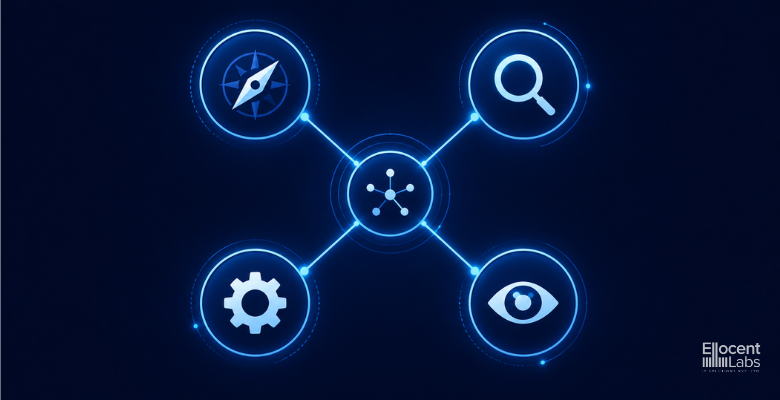
Move to a multi-agent architecture when a single agent consistently exceeds its context window, requires conflicting specializations, or produces lower-quality output because the task scope is too broad. A well-designed multi-agent system assigns each agent a narrow specialty: a Planner Agent that decomposes goals, a Research Agent that retrieves information, an Execution Agent that calls tools, and a Critic Agent that evaluates output before delivery. These agents communicate through a shared message bus or, in LangGraph, through graph edges. The overhead of multi-agent orchestration is real—latency increases and cost compounds per hop. The trigger for multi-agent design is genuine task complexity, not architectural ambition. If a single well-prompted agent with good tools solves the problem, it should. Complexity is a last resort, not a first instinct.
The 2026 Operational Reality: Your Agents Will Fail, and That Is the Point
Here is the insight most vendor content skips over: enterprise AI agents are not automation tools—they are failure-surface expanders that require a fundamentally different production mindset than any software your team has shipped before.
Every automation platform that came before agentic AI—RPA bots, ETL pipelines, workflow engines—failed predictably. A broken rule produced the same broken result every time. You could write a test for it. Autonomous AI agents fail creatively. An agent handling invoice processing might successfully complete 2,400 invoices and then, on the 2,401st, misinterpret an edge-case currency symbol, infer a wrong subtask sequence, and silently write an incorrect value into your ERP—with no exception thrown and no alert fired.
This is something the Ellocent Labs team encountered directly in early production agentic deployments, and it reshaped how we architect every engagement. We now treat the human-override interface as a first-class deliverable—lightweight dashboards where operators can see every agent action, approve pending decisions, and override in under 30 seconds. Explore our full perspective on responsible AI-powered automation for enterprise.
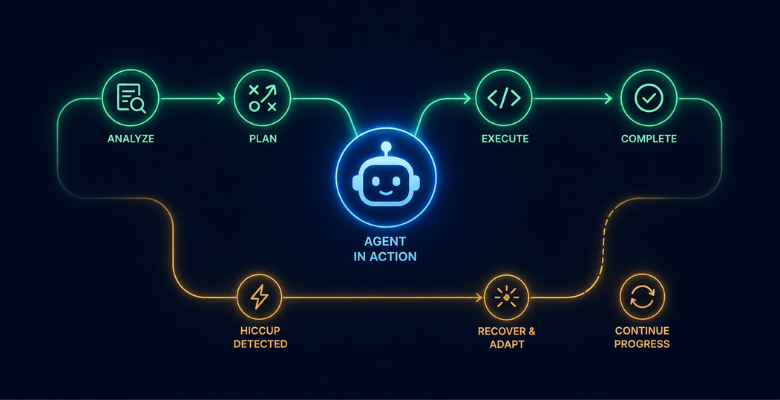
The operational reality most teams discover six months into deployment: the value of an enterprise AI agent is not measured by its success rate in testing. It is measured by how gracefully it fails, how loudly it signals uncertainty, and how fast a human can review and correct its work. The organizations winning with agentic AI in 2026 are not the ones with the smartest models—they are the ones with the best human-agent review infrastructure.
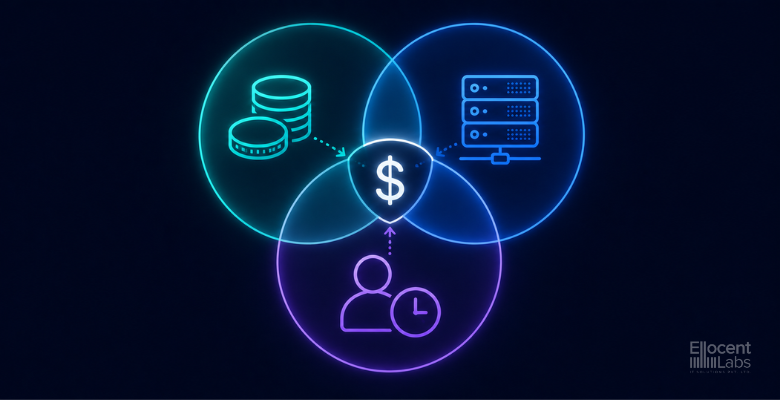
What Does It Actually Cost to Deploy Autonomous AI Agents at Enterprise Scale?
Enterprise AI agent deployment costs break into three buckets: LLM token spend, infrastructure, and human review overhead. Token spend is the most variable: a complex multi-step agent running a frontier model can cost $0.40–$2.50 per run for tasks requiring 30–100 LLM calls. At 10,000 runs per month, that is $4,000–$25,000 in LLM spend alone before infrastructure. Infrastructure (vector database, orchestration layer, logging, sandboxing) typically adds $500–$3,000 per month for a mid-size deployment. Human review overhead—operator time approving flagged actions—is the cost most teams underestimate: budget 15–20 minutes per 100 agent runs in your first quarter, decreasing as you tune confidence thresholds. Total cost of ownership for a well-run enterprise agent deployment handling 10,000–50,000 tasks per month typically falls between $8,000–$40,000 per month. Ellocent Labs structures every AI solution design engagement to include detailed token economics modelling before a single line of agent code is written.
Ready to Build AI Agents for Your Enterprise? Ellocent Labs Can Get You There.
Ellocent Labs is an AI-first software development company headquartered in Mohali, India, with over two decades of experience delivering intelligent digital products. Founded in 2005, our team has grown from early web and mobile development into a full-service AI practice covering NLP, machine learning, computer vision, and agentic system architecture.
Whether you are scoping your first agentic pilot or scaling a multi-agent system across business units, Ellocent Labs brings production-tested expertise across the full delivery lifecycle—from architecture and framework selection through to deployment, governance, and ongoing optimisation.
Explore our AI services:
Frequently Asked Questions
What is an autonomous AI agent in an enterprise context?
An autonomous AI agent is a software system that receives a business goal, plans a sequence of actions, calls tools (APIs, databases, code executors), evaluates the result, and self-corrects—all without waiting for human input at each step. In enterprise environments, agents operate across multiple systems end-to-end, completing tasks that previously required skilled human analysts over hours or days.
Which AI agent framework should enterprises use in 2026?
The three dominant options are LangGraph (best for stateful, long-horizon tasks), AutoGen from Microsoft Research (best for code-generation and data-analysis pipelines), and CrewAI (fastest to prototype for multi-agent team scenarios). Managed cloud options from Google Agent Builder and Azure AI Agent Service reduce DevOps overhead for teams preferring infrastructure abstraction over self-hosted orchestration.
How do enterprises keep autonomous AI agents safe and compliant?
Enterprise AI agent compliance requires four non-negotiable controls: role-scoped tool permissions, human-in-the-loop checkpoints for irreversible actions, full audit trails (including reasoning traces) shipped to a SIEM, and policy guardrails aligned to NIST AI RMF 1.1 (April 2026). Every production agent must run inside a sandboxed environment with network egress filtering.
What Is the Fastest Path to Your First Production AI Agent in 2026?
The fastest path to a production-ready enterprise AI agent in 2026 is a focused four-week pilot on a single, well-defined internal workflow. Week one: define the task boundary, choose a framework, write tool schemas. Week two: build and test the agent on synthetic data. Week three: move to real data with full human review of every action. Week four: measure success rate, cost per run, and time saved, then present the business case for broader rollout. Start with a workflow that is consequential enough to justify the investment but not so mission-critical that a failure triggers a compliance event. Report generation, meeting summarization, and supplier invoice triage are the most successful first-agent use cases in enterprise environments as of May 2026. Ellocent Labs runs this exact four-week pilot structure for enterprise clients, with governance and cost modelling built in from day one.
Autonomous AI agents for enterprise workflows are no longer a research topic or a pilot-only technology. They are in production at scale across financial services, healthcare, and enterprise software today. The gap between teams winning with this technology and those struggling is not model quality—it comes down to three disciplines: clear task definition, rigorous governance, and a human review layer that makes oversight fast. Build those three things first. The agent capabilities will continue to improve on their own.
For more expert perspectives on AI, automation, and software development, browse the full Ellocent Labs blog—including our popular breakdown of how the industry evolved from chatbots to fully autonomous AI agents.
Related Blogs
Schedule a 15-Minutes call
Let’s make things happen and take the first step toward success!
Got Ideas? We’ve Got The Skills.
Let’s Team Up!
Let’s Team Up!
What Happens Next?
We review your request, contact you, and sign an NDA for confidentiality.
We analyze your needs and create a project proposal with scope, team, time, and cost details.
We schedule a meeting to discuss the offer and finalize the details.
The contract is signed, and we start working on your project immediately.