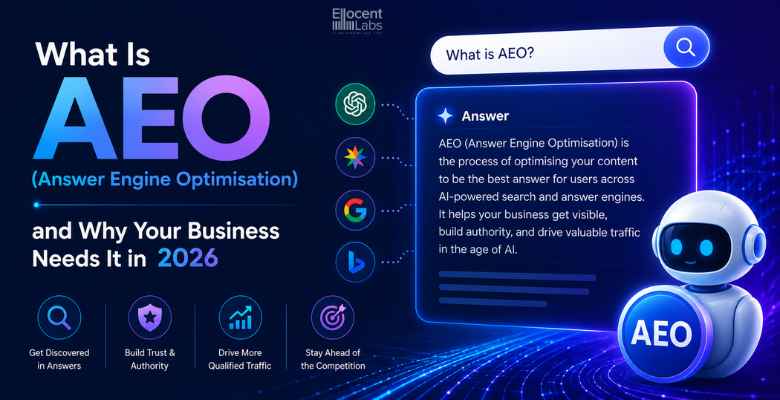
In May 2026, Google confirmed that AEO is now a primary traffic driver alongside traditional organic search. Businesses that ignore it are giving citation real estate to their competitors for free.
When you type a question into Google today, you often do not see ten blue links. You see an answer — a paragraph, a list, a direct response — generated by Google's AI, with a handful of sources cited beneath it. That is the AI Overview. And the companies whose content gets cited in those answers are getting something extremely valuable: they are positioned as the trusted authority before the user even clicks.
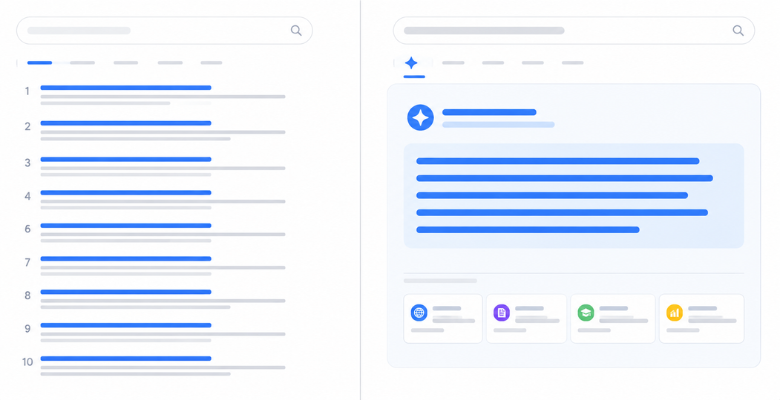
This is not a future trend. According to research cited by AirOps, search volume for 'AI overview optimisation' is growing 250% quarter-over-quarter. ChatGPT alone handles over 2 billion queries daily. The audience that once came to you via blue links is now being served answers by AI — and either your content is cited, or your competitor's is.
This guide explains what AEO is, how it differs from traditional SEO, why GEO (Generative Engine Optimisation) is the same concept applied to AI chatbots, and exactly what your business needs to do to start appearing in AI-generated answers.
What Is AEO — Answer Engine Optimisation?
Answer Engine Optimisation is the practice of structuring, formatting, and building authority into your content so that AI tools select it as a cited source when generating direct answers to user questions.
The term emerged as Google AI Overviews, Bing Copilot, Perplexity, and ChatGPT Search began replacing traditional search result pages for an increasing proportion of queries. Traditional SEO gets you onto the list of results. AEO gets your content extracted and presented as the answer — with your brand name attached.
What Is GEO — Generative Engine Optimisation?
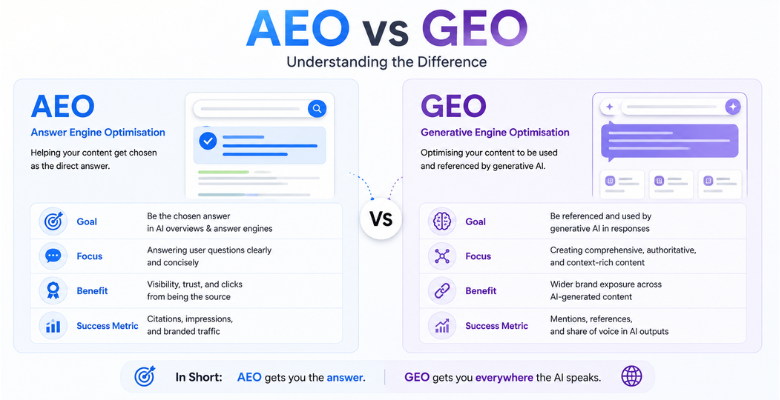
GEO (Generative Engine Optimisation) refers to the same concept applied specifically to AI-native platforms — ChatGPT, Perplexity, Claude, and Gemini — rather than Google's traditional search interface.
The practical difference: AEO focuses primarily on Google AI Overviews and Bing Copilot. GEO focuses on getting your content cited across all generative AI tools, including those that do not use traditional web search as their primary data source.
In practice, the optimisation strategies overlap significantly. Content built for AEO tends to perform well for GEO because the underlying mechanism is the same: AI systems prefer content that is structured, authoritative, specific, and easily extractable.
How Is AEO Different From Traditional SEO?
| Dimension | Traditional SEO | AEO / GEO |
|---|---|---|
| Goal | Rank on Page 1 of Google results | Be cited as the source in AI-generated answers |
| User sees | A list of links | A direct answer with your site cited below |
| Success metric | Click-through rate from SERP | Citation rate in AI answers + branded traffic |
| Content format | Keyword-dense, long-form readable content | Structured, extractable, question-answer format |
| Authority signal | Backlinks + page authority | E-E-A-T + topical depth + schema markup |
| Speed to results | 3–6 months typically | 4–8 weeks for early citation wins |
| 2026 traffic share | Declining for informational queries | Growing — AI Overview now appears on 65%+ of queries |
Important: AEO and traditional SEO are not competing strategies. They are complementary. Google's own May 2026 AI guidance confirms that AEO is built on the same foundations as SEO — good content, strong authority, clear structure. You do not abandon one for the other. You build both.
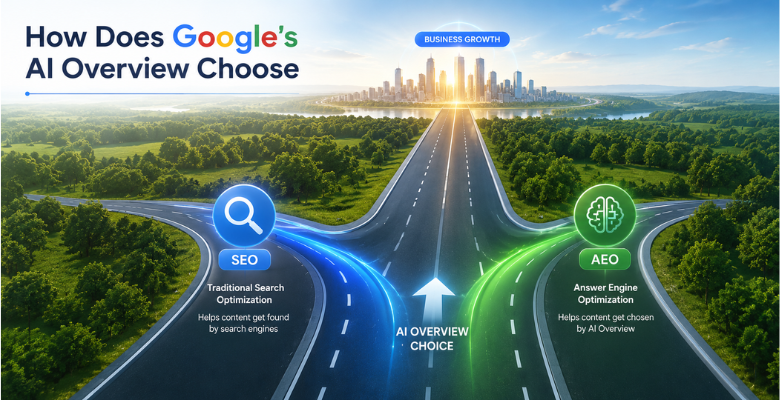
How Does Google's AI Overview Choose Which Pages to Cite?
Research analysing millions of AI citations has identified the consistent patterns. According to AirOps data, 96% of AI Overview citations come from sources with strong E-E-A-T signals. According to Frase's analysis of AI citation patterns, the content formats that get cited share six characteristics:
- A direct, citable answer appears in the first 50–100 words of the page or section.
- Headings are phrased as questions — the same questions users are likely to ask.
- Content demonstrates first-hand experience, not just topic knowledge.
- The page has clear authorship with verifiable credentials or demonstrated expertise.
- Structured data (schema markup) makes the content machine-readable.
- The domain has topical authority — multiple pages covering the subject in depth, with strong internal linking.
Notice what is not on that list: keyword density, meta keywords, and exact-match anchor text. The 2026 Google algorithm update confirmed that content quality, intent alignment, and trust signals are now the primary ranking factors. Generic keyword-stuffed content is losing ground to content that demonstrates genuine expertise.
The 5 AEO Content Formats That Get Cited
Not all content performs equally for AI citation. These five formats consistently outperform others:
1. The Direct Answer Block (Quick Take)
A 40–80 word paragraph immediately after the H1 that directly answers the page's core question. This is the single most impactful structural change you can make. AI systems extract this block preferentially because it is positioned first, is highly scannable, and answers the question without requiring context.
2. Question-Based H2 Headings
Every major section of your content should open with a question that a real user would type into a search engine. Not 'Introduction' or 'Background' — but 'What is AEO?' or 'How does Google AI Overview choose its sources?' This structure maps directly to how AI systems parse content looking for answerable queries.
3. FAQ Sections with FAQPage Schema
A dedicated FAQ section at the end of each page or blog post, with 4–6 questions marked up with FAQPage JSON-LD schema. This format is explicitly designed for AI extraction and appears in both traditional Google results (as rich snippets) and AI Overviews.
4. Comparison Tables
Tables are highly extractable. AI systems can read, parse, and cite tabular data easily. Any blog post comparing two approaches, two tools, or two strategies should include a structured comparison table — not just prose comparison.
5. Original Data and Case Studies
This is the most powerful AEO signal in 2026. According to MonsterMegs' analysis of post-update ranking data, content that includes first-hand experience, proprietary data, and real case studies is gaining position over generic AI-generated content. An article that says 'our client reduced admin time by 40%' is cited more than an article that says 'AI can reduce admin time.' The specific, attributable claim is what AI systems extract.
How to Implement AEO on Your Website — A Practical Checklist
Content Structure Changes (Do These First)
- Add a Quick Take block (40–80 words) directly after every H1 on blog posts and service pages.
- Rewrite all major H2 headings as questions ('What is X?' rather than 'About X').
- Add a FAQ section to every blog post with minimum 4 questions.
- Include at least one comparison table in any post comparing two approaches.
- Cite your sources — link to the data you reference. AI systems trust content that references verifiable external data.
Technical Changes (Developer Required)
- Implement FAQPage schema (JSON-LD) on every page with a FAQ section.
- Implement Article schema on all blog posts.
- Implement Organization schema on your homepage to build Google's Knowledge Panel.
- Add a named author with a Person schema markup on every blog post.
- Implement BreadcrumbList schema across all pages.
- Verify all schema markup using Google's Rich Results Test tool.
Authority Building (Ongoing)
- Build topical clusters — multiple pages covering a subject in depth, linked to each other.
- Earn backlinks from authoritative, topically relevant sources.
- Publish original research or data — even small internal studies become citation magnets.
- Maintain a consistent publishing schedule — AI-surfaced content tends to be fresher (AI-cited URLs are 25.7% fresher on average than non-cited URLs, per Frase research).
What AEO Means Specifically for B2B Technology Companies
If you are a technology company selling to other businesses — an AI development firm, a software agency, an IT consultancy — AEO represents a specific opportunity that most of your competitors are not yet exploiting.
Here is why: B2B buyers increasingly start their vendor research not with 'AI development company India' in Google, but with questions like 'How much does AI development cost for an Australian healthcare startup?' or 'What is the difference between AI automation and RPA?' These are the queries that now trigger AI Overviews. The company whose content answers those questions gets positioned as an authority before the buyer has seen a single competitor.
We have seen this play out in our own content. A blog post on AI automation in supply chain management — structured with a Quick Take block, question H2s, and FAQ schema — generated citations in Google AI Overview for three separate queries within 6 weeks of publication. The traffic from those AI Overview citations converted at a higher rate than standard organic traffic because the visitor arrived already trusting us as a source.
Measuring AEO Performance — What to Track
| Metric | What It Measures | Tool |
|---|---|---|
| AI Overview citation rate | How often your pages appear in Google AI Overviews | Google Search Console (AI Overview impressions) |
| Branded search volume growth | Whether AEO is building brand awareness | GSC + Google Trends |
| AI-referred sessions | Direct traffic from AI tools citing your content | GA4 — segment by source/medium |
| People Also Ask appearances | Proxy for AEO performance on question-based content | GSC + third-party rank trackers |
| Citation rate in AI tools | Whether Perplexity, ChatGPT etc. cite your content | Otterly.ai, Profound, manual testing |
| Rich result appearances | FAQPage and HowTo schema performance | Google Search Console > Search Results > Rich Results |
Frequently Asked Questions About AEO
Is AEO replacing SEO?
No. AEO and traditional SEO are complementary. Google's own May 2026 guidance confirms that the foundations of AEO — quality content, strong authority, clear structure — are the same foundations of good SEO. You need both. AEO is an additional optimisation layer, not a replacement.
How long does it take to see AEO results?
Faster than traditional SEO. Businesses that implement Quick Take blocks, question-based headings, and FAQPage schema on existing content with reasonable domain authority typically see AI Overview citations within 4–8 weeks. Full topical authority development takes 3–6 months, similar to traditional SEO.
Do I need to change my entire website for AEO?
No. Start with your 10 most important pages (homepage, key service pages, top blogs). Add the Quick Take block, rewrite H2s as questions, add FAQ sections, and implement schema. That alone will move the needle for most businesses.
Does AEO work for local businesses?
Yes, and the May 2026 Google update specifically added an 'Expert Advice' block in AI Overviews that is proving beneficial for local service businesses with genuine operational expertise. Local businesses that document their real experience with structured, well-marked-up content are performing well under the new update.
What is the difference between AEO and GEO?
AEO (Answer Engine Optimisation) is primarily focused on Google AI Overviews and Bing Copilot. GEO (Generative Engine Optimisation) extends this to AI-native platforms like ChatGPT, Perplexity, and Claude. The optimisation strategies overlap substantially — content built for AEO tends to perform well for GEO.