Smart, Secure and Scalable Healthcare IT Solutions
Ellocent enhances healthcare IT service provision dedicated to all augmentation of diagnostics and patient management. Ellocent equips healthcare personnel with technology to simplify Multi-disciplinary clinical services, data organization and Inter-system connection.
Integrated Hospital Management & Information System (IHHMIS)
Cybersecurity and Data Protection Sophisticated AI Technical Solutions
Protect your business with advanced AI technologies. Our solutions utilizing AI, blockchain, and cloud technology offer reliable business-grade security while ensuring private data protection.
AI-Powered Threat Detection & Fast Response
Computer access is monitored around-the-clock by AI which ensures any threats will be dealt with immediately. Security systems are trained to recognize and learn behavior patterns to identify anomalies swiftly. Immediate action is taken to mitigate damages. To improve analysis and decision making all data is gathered and analyzed from a single security data repository.
Trustworthy Data Masking and Encryption for Your Business
Data is well protected with encryption whether in motion or stored. AI helps conceal personal information to guarantee safety and privacy. Meet global standards like HIPAA,GDPR,PCI-DSS. Multiple levels of access denial are enforced on the cloud.
Zero Trust Security, Smart Access Control
MFA, Smart Identity Check, and Biometric ID are required for user acceptance. Verification techniques other than the bare minimum will be utilized. Access is limited strictly to what’s necessary. Nothing more is to be added. With every interaction, AI adapts the level of access granted based on behavior and associated risk thresholds. Safely and seamlessly using one sign-on (SSO) enables access to multiple resources.
Blockchain for Secure Transactions & Data Integrity
Smart contracts eliminate the possibility of manipulation in online transactions. Decentralized IDs aid in the prevention of identity theft or unauthorized access. Blockchain aids in the easy retrieval of comprehensive tracking and audit records. Data is protected with cryptographic claims of integrity through data tampering.
Cloud Security Made Smarter with AI
Safe cloud infrastructure including: AWS, Azure, Google. AI prevents intrusions to mitigate damage. DDoS attack protection that attempts to bring down your systems. Automated Black Hat checks fortify insecure areas before hackers seize the opportunity.
Fraud Prevention & Safer Payments
Real time intervention schemes that shut down fraudulent actions at once. Payment data Protects customer information with encrypted payment gateways. Dynamic chargeback fraud and phishing protection ceaseless security. Payment information tokenized during processes to ensure guarded management.
Cybersecurity for IoT & Smart Devices
Complete defense coverage for connected devices and smart tech. Defensive software updates to patch vulnerabilities. Unsupervised behavior monitoring AI checks every device for unusual activity. Cross-network data protection ensures security throughout your entire network.
AI for Compliance & Risk Management
Automated reporting to provide user documents experts to compliance guidelines. AI Fortify your system to check for gaps in security measures within the infrastructure. Preemptive action aim predicts hostile attempts and neutralizes them in advance. Data retention helps in auditing, incident scrutiny, and tracking.
Sectors We Empower with Technology
The tailored IT and cybersecurity services we provide are customized to solve all of your problems. We help grow your business. We make sure that from protecting critical information to creating robust systems, you can expand with peace of mind. Technology serves you regardless of whether you are in finance, healthcare, retail, or other sectors.
Finance & Banking
Transactions are safeguarded by Encryption and Fraud Detection. Compliance-focused FinTech apps. DevOps and Cybersecurity analysts with relevant experience.
Healthcare
Protecting data with HIPAA compliance and secure EHR systems. Telehealth development with strong encryption. Outsource health tech development and support.
E-Commerce & Retail
Prevent fraud and secure onsite payments. Custom ecommerce platform development. ProFront and backend development services.
Education & Edtech
Protection of digital content and student data. Custom LMS and mobile learning application development. EdTech developers and UX UI designers staffing.
Secure & Compliant Healthcare Software
We develop healthcare telehealth software with the highest industry security compliance including HIPAA and GDPR. Our experts are well-versed in cybersecurity and utilize robust data protection methodologies to ensure sensitive healthcare information is kept safe.
Data Encryption and Pseudonymization: Protecting patient details using advanced encryption techniques.
Access Control Measures: Restricting data access to select individuals.
Regulatory Compliance: Compliance with HIPAA, HITECH Act, GDPR, ISO 13485, IEC.
Data Integrity Control: Maintaining accurate and undamaged medical records.
Administrative Safeguards Consulting: Provides advice regarding the policies designed for data protection.
Tailored Logistics Solutions for Every Industry
We serve a wide scope of medical and healthcare organizations with advanced IT solutions. We develop the necessary software and integrate it into the existing systems with the ultimate goal of optimizing processes, improving patient care, and achieving digital transformation.
Cloud Solutions for Enterprises
Cloud migration & modernization to streamline business processes.
Startups & SMEs
For small businesses and startups, we offer cost-effective and scalable cloud solutions.
SaaS Companies
We enable SaaS providers with safe and scalable cloud platforms.
Cloud Security & Compliance
We adopt cutting-edge cloud security solutions to guarantee data protection.
Cloud Infrastructure & Managed Services
We deliver cloud infrastructure end-to-end management.
AI & Big Data in the Cloud
Leverage the potential of AI and Big Data with cloud computing for real-time.
Cloud-Based DevOps & Automation
We assist companies in adopting cloud DevOps practices to make them more productive.
Cloud Disaster Recovery & Business Continuity
We provide cloud-based disaster recovery solutions to minimize downtime and ensure.
Complying with Security Regulations and Legal Obligations
Industry compliance legal terms infrastructure safeguards the US healthcare system. We develop healthcare applications that protect the interests of the product and users while meeting the requirements of the healthcare system of the United States and the entire globe.
FDA (Food & Drug Administration)
Responsible for ensuring safety, efficacy, and security of drugs, devices, and biological products and including their medical uses.

HIPAA (Health Insurance Portability and Accountability Act)
Mandates that sensitive data in the form of healthcare and other information shall be preserved without breach of privacy or security of the specific industry.

EHR (Electronic Health Records)
Designed to guarantee effective collaboration among providers and institutions to reduce the burden of managing information on patients among healthcare service providers.

HITECH (Health Information Technology for Economic and Clinical Health Act)
Incorporates effective security audits deemed necessary to be passed by all mobile health applications and supports privacy and security based on HIPAA or HITECH
Smarter Healthcare Operations through Seamless EHR Integration
We enhance patients' welfare by providing seamless EHR integration services to guarantee effective data exchange. Your current systems are seamlessly integrated with leading EHRs by our professionals, optimizing processes and improving healthcare management efficiency and interoperability.
Medical and the Software We Integrate with EHR
We integrate multiple medical software with EHR for better data transfer, improved workflows, and better patient outcomes. We have specialized knowledge in many areas such as patient services, facility automation, clinical services, and sophisticated analytics, creating a full-fledged experience in healthcare.
Patient Interaction & Care Management
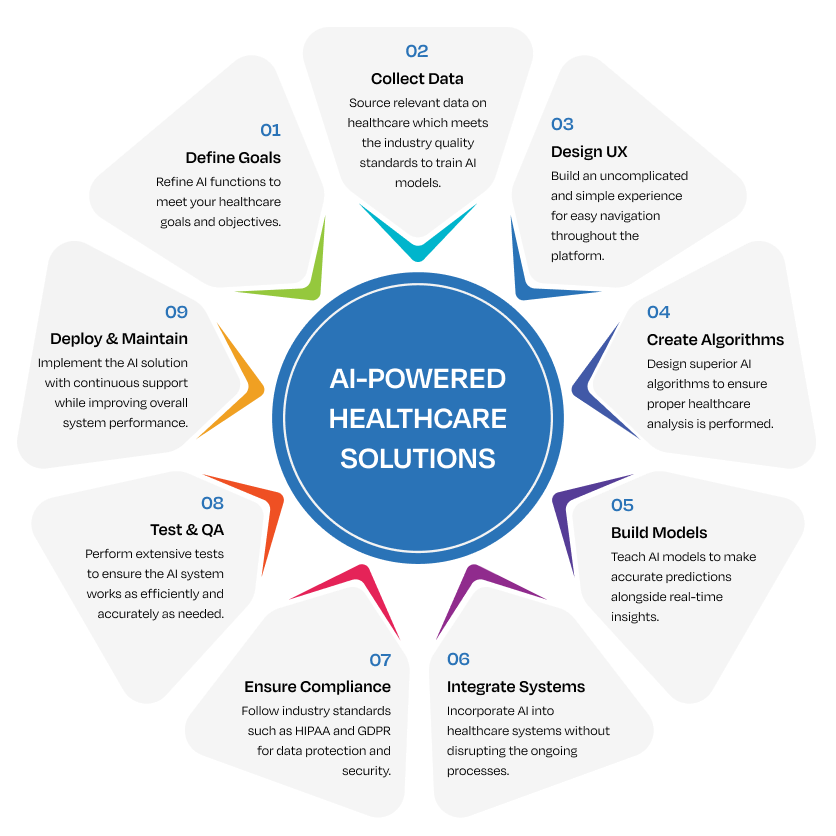
Our Proven Process for Building AI-Powered Solutions
We specialize in cloud solution development, enabling companies to migrate, optimize, and grow their digital infrastructure with high-performing, secure cloud services. Our systematic cloud development process guarantees smooth integration, compliance, and efficiency and accelerates digital transformation.
Our AI Integration
This section gives an overview of our Cloud Services Tech Stack, which allows businesses to create scalable, secure, and high-performance cloud solutions:
Whisper
GPT 4o
PaLM 2
Claude Ai
Dalle-2
Llama-3
Gemini Ai
Vicuna
Mistral AI
Bloom-560m
Benefits of Innovative Software Solutions
Healthcare software development increases operational effectiveness, enhances patient care, and simplifies processes. From efficient data collection and automated workflow processes to AI telemedicine and diagnostics, it enables advanced, rapid, and precise healthcare solutions. Embrace modern technology and secure your medical services for the future.

Related Blogs
The coordination of the projects is not only a matter of monitoring tasks. It is all about linking individuals, procedures, and priorities to get things done smoothly. No project coordinator will go without difficulties. The crucial one is to know how to address them. The list of the top 10 challenges in project coordination is given here, and some tips on how to overcome these challenges, which can be applied in practice.
1. Unclear Goals

- The challenge: When the project goals are not set, the teams may either waste time on guesses about what matters or do what is not important.
- How to overcome: Have a clear plan, written objectives, and success measurement methods at the start of any project.
2. Resource Constraints

- The challenge: A Lack of enough people or tools may slow it down.
- How to overcome: Get your needs evaluated at the early stage and have a backup plan, and be honest with all about the limits..
3. Poor Communication

- The challenge: Due to miscommunication, the deadline may be missed, some work will be done twice, or the roles may be misunderstood.
- How to overcome: Choose obvious methods of communication, ensure that all are understood, and keep up-to-date.
4. Priorities Conflicts

- The challenge: It may be that the team members are dealing with a number of projects simultaneously, and it may be difficult to concentrate.
- How to overcome: Make & share deadlines clearly. Request the team members to raise the alarm early in case of conflicts, in order to make adjustments to the priorities.
5. Keeping Track of Documents

- The challenge: Lost information or outdated documents may result in errors and unproductive work.
- How to fix it: All project documents should be in one place. Ensure that they are updated whenever necessary and are sporadically checked by anyone to ensure that they are right and easy to locate.
6. Absence of Stakeholder Engagement

- The challenge: When the stakeholders are not consulted or unresponsive, it leads to delays in projects
- How to fix it: Conduct regular meetings, inform them about the progress, and consult them during the decision-making process. Demonstrate to them the difference in their participation.
7. Time Management Issues

- The challenge: It might become overwhelming to organize several things and deadlines, which will result in delays.
- How to overcome: Use project management tools to track progress & prioritize tasks along with timelines. Divide large tasks into small milestones to have better focus.
8. Changing Requirements / Scope Creep

- The challenge: The project continues to be delayed as clients/stakeholders continue to alter their demands.
- How to overcome: Be specific about what is in it at the beginning. In case new requests are received, go through them and consult the team, and only approve the necessary changes.
9. Missed Deadlines

- The challenge: Delays in the tasks, which influence the entire project.
- How to overcome: Break down work into smaller tasks with clear deadlines & track the progress regularly. If a task is falling behind, reallocate resources or escalate early.
10. Risk Management

- The challenge: Unexpected issues can cause project delays.
- How to overcome: Identify risks at the start and list them. Review and update risks every week. A proactive approach prevents small problems from becoming big crises.
Final Thoughts:
The role of project coordination is in transforming ideas into achievements, but it is not without its challenges. Being able to manage the communication gaps, shift the priorities, and address the resource constraint issues as well as the expectations of the stakeholders, the job of a project coordinator requires flexibility, planning abilities, and effective problem-solving skills.
The secret of overcoming these typical problems is planning well, proper communication, risk management as they arise, and appropriate tools. Coordinators can address issues and ensure a project remains on track with proper organization by maintaining readiness, teamwork, and remembering the purpose of the project.
Ultimately, all challenges are learning opportunities to become better and more favorable in handling projects. Under the right approach and attitude, project coordinators not only do the work, but they also contribute to the success of the project.
Facing project coordination hurdles? Ellocent Labs offers expert project management solutions and tools to keep your teams aligned and projects on track. Reach out today!
Discover how AI automation will create self-healing supply chains in 2026. Learn about cognitive logistics, autonomous planning, and how Ellocent Labs builds future-proof solutions.
Introduction: The Dawn of Autonomous Supply Chains
In 2026, supply chain complexity has reached an inflection point. With 73% of enterprises now managing distributed multi-cloud operations across at least 15 different systems, traditional optimization approaches have hit their limits. The old paradigm of human-led decision-making simply cannot process the 12.7 million data points generated by a modern logistics network every hour.
The transformation we're witnessing isn't about incremental improvement—it's about evolutionary change. AI Automation in Supply Chain Management has matured beyond predictive analytics into cognitive operations. This guide provides the 2026 strategic framework for building supply chains that don't just predict disruptions, but autonomously reconfigure themselves to maintain optimal flow. You'll learn how leading organizations are achieving 40-60% improvement in operational resilience while reducing planning overhead by 80%.
The 2026 Framework: From Predictive to Cognitive Operations
The most significant shift since 2024 has been the transition from systems that assist human decision-makers to systems that own entire operational domains. The 2026 cognitive framework operates on three planes simultaneously.
1. Autonomous Network Orchestration
Modern supply chains no longer follow linear paths but exist as dynamic multi-dimensional networks. AI systems now continuously evaluate 47+ variables per transaction—including real-time carbon costs, supplier ESG scores, and geopolitical risk indices—to autonomously route goods through the optimal network path. These systems make thousands of micro-decisions daily without human intervention, creating what Gartner terms "self-healing supply networks."
2. Generative Planning & Simulation
The breakthrough of GenAI in supply chain planning has been transformative. Instead of analysts running scenarios, generative AI systems now create and evaluate millions of potential futures in simulation environments. Our teams at Ellocent Labs build custom AI solutions that leverage quantum-inspired algorithms to model entire global networks, identifying optimal configurations for everything from routine operations to black swan events.
3. Embedded Intelligence Ecosystems
AI is no longer a separate "system"—it's embedded in every component. From smart containers that negotiate their own last-mile delivery slots to warehouse robots that dynamically reorganize storage patterns based on predicted demand, intelligence is distributed. This requires a fundamentally different architectural approach, which we specialize in through our enterprise IoT integration practice.
The 2026 Tech Stack: Quantum Computing, Neuromorphic Chips, and Digital Twins
The underlying technology enabling this transformation has advanced dramatically:
- Quantum-Inspired Optimization: While full-scale quantum computing remains in development, quantum-inspired algorithms running on specialized hardware are solving previously intractable optimization problems. Route optimization that once took hours now occurs in milliseconds, evaluating factors from weather disruptions to port congestion in real-time.
- Neuromorphic Processing: For real-time decision-making at the edge, neuromorphic chips—which mimic the brain's neural structure—process sensor data with 1,000x greater energy efficiency than traditional chips. This enables truly autonomous decision-making in remote locations without cloud dependency.
- Living Digital Twins: The digital twin has evolved from a static model to a living system that continuously learns from its physical counterpart. Our recent supply chain digital twin implementation for a pharmaceutical client reduced clinical trial logistics costs by 34% by simulating and optimizing the entire cold chain network before physical deployment.
- Blockchain + AI Integration: Smart contracts have matured into cognitive contracts that automatically adjust terms based on AI-analyzed performance data. This creates self-governing partnerships where incentives automatically align with outcomes. Explore our work in enterprise blockchain solutions that make this possible.
The 2026 Business Impact: Metrics That Matter
The organizations that embraced AI automation early are now seeing compound returns:
- 47% Reduction in End-to-End Cycle Times: Autonomous systems compress planning, execution, and adjustment cycles from weeks to hours.
- $8.3M Average Annual Savings per $1B in revenue through waste elimination and capital optimization.
- 99.7% Forecast Accuracy at the SKU-location level, transforming inventory from a cost center to a strategic asset.
- 43% Improvement in Sustainability Metrics through AI-optimized routing, load consolidation, and circular economy integration.
Most significantly, these organizations report 92% reduction in fire-fighting and crisis management—leadership attention has shifted from operational troubleshooting to strategic innovation.
Implementation Roadmap for 2026: Starting Your Autonomous Journey
For technology leaders looking to build or modernize their capabilities, the 2026 playbook focuses on three key initiatives:
Phase 1: Establish Your Cognitive Core (Q1-Q2 2026)
Begin not with point solutions but with a foundational cognitive data fabric. This unified data layer, built on principles we've refined through our cloud modernization practice, must ingest, contextualize, and serve data to any AI application. Start with one high-impact use case—like autonomous inventory rebalancing—to prove value while building the foundation.
Phase 2: Deploy Your First Autonomous Domain (Q3-Q4 2026)
Select one operational domain where you can implement full autonomy. Transportation management is often ideal—our recent logistics automation project achieved 89% autonomous decision-making for a retail client's last-mile delivery network within six months. Critical success factors include clear autonomy boundaries and human-in-the-loop oversight protocols.
Phase 3: Scale the Autonomy Network (2027 Planning)
With proven success in one domain, architect the expansion to connected domains. This requires moving from standalone AI applications to an orchestrated autonomy framework where multiple AI systems collaborate. Our enterprise architecture approach ensures these systems interoperate securely and efficiently as you scale.
The Human Element in Autonomous Supply Chains
A critical 2026 insight: Full automation doesn't mean eliminating people—it means elevating human roles. As routine decisions become automated, supply chain professionals transition to:
- Autonomy Architects who design decision-making frameworks and ethical boundaries
- AI Trainers who continuously improve system intelligence through reinforcement learning
- Strategic Orchestrators who manage the interactions between multiple autonomous systems
This human-AI collaboration requires new skills and organizational structures. Companies investing in change management and training alongside technology implementation see 3.2x faster adoption and 76% higher ROI.
Beyond 2026: The Convergence of Physical and Digital
The next frontier is the complete convergence of physical and digital operations:
- Self-Optimizing Physical Networks: Infrastructure that dynamically reconfigures itself—warehouse layouts that change based on predicted demand, ports that automatically adjust berthing based on vessel AI profiles.
- Predictive Sustainability: AI systems that don't just reduce carbon footprint but actively contribute to carbon-negative operations through circular economy optimization.
- Cognitive Supplier Ecosystems: Entire supply networks that function as single intelligent organisms, with risk and opportunity automatically flowing to the best-positioned participants.
The technology foundations for these capabilities are being built today. Organizations that delay their autonomous transformation risk not just competitive disadvantage but existential threat in markets where microseconds and milligrams determine profitability.
Conclusion
The supply chain of 2026 isn't managed—it's orchestrated. It doesn't respond—it anticipates. It doesn't break—it adapts. The transition from predictive to cognitive operations represents the most significant operational transformation since the advent of container shipping. The organizations leading this change are achieving unprecedented levels of resilience, efficiency, and strategic advantage.
The window for building foundational capabilities is now. By 2027, the gap between autonomous and traditional supply chains will become unbridgeable for most organizations.
Is your supply chain ready for autonomous operations? Our 2026 Supply Chain Autonomy Assessment evaluates your current capabilities against industry benchmarks and provides a customized roadmap.
Schedule a Discovery Session with Our Autonomy Specialists to begin your transformation.
The online world is always changing, and 2025 is a big year for how businesses get found on search engines. You might hear some people say, “SEO is dead,” but that’s not true at all! Instead, SEO is simply growing and changing, mostly because of Artificial Intelligence (AI) in search. This isn’t a problem; it’s a huge chance for those who are ready to learn and adapt. Google isn’t just counting keywords anymore; it’s looking at how good your content is, what it means, and how easy it is for people to use.
To do well in this new world, businesses need to go beyond old SEO tricks. They need to use a smarter, more connected way of thinking. This means understanding and combining four key ideas: AI Optimization (AIO), Generative Engine Optimization (GEO), Answer Engine Optimization (AEO), and Search Experience Optimization (SXO). These techniques, when used together, are vital for keeping your company prominent and competitive online.
The traditional notion of simply “ranking” high is evolving. Today, it’s more a question of “being the answer” or “being mentioned” by machines. This implies that success is no longer merely the click on a blue link. It is about being the authoritative source that a machine mentions. This alters the manner in which companies define success and strategize their content.
Understanding the New SEO Terms

Let’s break down these new terms to see how they fit into the future of SEO.
AIO: AI Optimization
Making your website’s content simple for AI-driven search engines to comprehend and summarize is the main goal of AI Optimization (AIO). Consider it a way to make your material “machine-readable.” Google’s AI Overviews, which provide instant responses directly on the search page, are expanding. This suggests that fewer people might visit your website. However, Google is making these AI Overviews more link-rich, so even if your website is small, it will still be seen. Getting your brand recognized and highlighted in these AI summaries is now the primary goal, rather than simply generating clicks.
GEO: Generative Engine Optimization
Generative Engine Optimization (GEO) is all about creating your content in such a high quality that AI tools like Google’s Search Generative Experience (SGE) prefer to use it when they generate their answers. It’s all about being the go-to source that AI quotes or mentions. Unlike classical SEO, which desires a click, GEO desires your content to be “the answer” itself. This is to say that your content must be extremely clear, credible, and display actual expertise. AI adores unique insights, original research, and facts that it simply can’t manufacture on its own.
AEO: Answer Engine Optimization
Answer Engine Optimization (AEO) focuses on making your content give direct, short answers to people’s questions. This helps your content show up in “featured snippets” (those quick answer boxes at the top of Google), “People Also Ask” sections, and especially in voice search results. With devices like Alexa and Siri, people get spoken answers without seeing website links. So, being the main source for an answer engine not only makes you more visible but also shows your brand as a trusted expert. AEO means using natural language and answering questions directly, often in a Q&A style.
SXO: Search Experience Optimization
Search Experience Optimization (SXO) involves marrying traditional SEO with the way users really behave on your site (User Experience or UX). Its primary purpose is ensuring that after finding your site, users have an easy, quick, and pleasant time. If your website is slow to load or difficult to navigate on mobile, users will leave quickly, regardless of your search ranking. SXO ensures your site is engaging and user-friendly, helping to keep visitors and encouraging actions like sign-ups and purchases.
How They Work Together for Maximum Impact
The real power of these four strategies lies in their combined use. They are not separate ideas; they work hand-in-hand to make each other stronger.
- AIO lays the groundwork by making your content easy for AI to understand.
- Then, GEO uses that understanding to get your content mentioned and quoted by AI.
- AEO builds on this by making your content appear as direct answers in search results and voice searches.
- Finally, SXO ensures that when people visit your site, they have a great experience, which encourages them to stay and convert.
This creates a positive cycle: good content that AI understands leads to more mentions, which leads to more direct answers, and a great website experience keeps people happy and coming back. This combined approach helps your brand be seen and trusted everywhere online, not just in traditional search results.

Simple Steps to Get Started
To use these strategies, focus on quality, what users want, and a good technical setup:
- Create Great Content:
- Be an Expert: Show your experience, knowledge, and trustworthiness. Mention your sources and have real experts write your content.
- Keep it Clear and Short: Structure your content with clear headings, bullet points, and Q&A sections so AI can easily pull out answers.
- Use Schema Markup: This is like giving AI a map of your content, helping it understand what your page is about.
- Think Like a Human: Use natural, conversational language, especially for voice search.
- Make Your Website Fast and Easy to Use:
- Speed Matters: Make sure your website loads super fast on all devices, especially phones.
- Easy to Navigate: Design your website so people can easily find what they’re looking for.
- Engaging Visuals: Use good images, videos, and charts to make your content more interesting.
- Build Trust and Authority:
- Become a Go-To Source: Create lots of detailed content on your topic to show you’re an expert.
- Get Good Links: Get links from other trusted websites.
- Local SEO: If you have a physical business, make sure your Google Business Profile is updated and get local reviews.
Looking Ahead
The world of SEO is always changing, but human expertise is still key. AI tools can help with research and content ideas, but real creativity, unique ideas, and building trust still come from people. The future of SEO is exciting, and by embracing these new, connected strategies, your business can stay ahead and truly shine online.
SEO Trends 2025: Making Your Brand Shine with AIO, GEO, AEO and SXO
The online world is always changing, and 2025 is a big year for how businesses get found on search engines. You might hear some people say, “SEO is dead,” but that’s not true at all! Instead, SEO is simply growing and changing, mostly because of Artificial Intelligence (AI) in search. This isn’t a problem; it’s a huge chance for those who are ready to learn and adapt. Google isn’t just counting keywords anymore; it’s looking at how good your content is, what it means, and how easy it is for people to use.
To do well in this new world, businesses need to go beyond old SEO tricks. They need to use a smarter, more connected way of thinking. This means understanding and combining four key ideas: AI Optimization (AIO), Generative Engine Optimization (GEO), Answer Engine Optimization (AEO), and Search Experience Optimization (SXO). These techniques, when used together, are vital for keeping your company prominent and competitive online.
The traditional notion of simply “ranking” high is evolving. Today, it’s more a question of “being the answer” or “being mentioned” by machines. This implies that success is no longer merely the click on a blue link. It is about being the authoritative source that a machine mentions. This alters the manner in which companies define success and strategize their content.
Understanding the New SEO Terms

Let’s break down these new terms to see how they fit into the future of SEO.
AIO: AI Optimization
Making your website’s content simple for AI-driven search engines to comprehend and summarize is the main goal of AI Optimization (AIO). Consider it a way to make your material “machine-readable.” Google’s AI Overviews, which provide instant responses directly on the search page, are expanding. This suggests that fewer people might visit your website. However, Google is making these AI Overviews more link-rich, so even if your website is small, it will still be seen. Getting your brand recognized and highlighted in these AI summaries is now the primary goal, rather than simply generating clicks.
GEO: Generative Engine Optimization
Generative Engine Optimization (GEO) is all about creating your content in such a high quality that AI tools like Google’s Search Generative Experience (SGE) prefer to use it when they generate their answers. It’s all about being the go-to source that AI quotes or mentions. Unlike classical SEO, which desires a click, GEO desires your content to be “the answer” itself. This is to say that your content must be extremely clear, credible, and display actual expertise. AI adores unique insights, original research, and facts that it simply can’t manufacture on its own.
AEO: Answer Engine Optimization
Answer Engine Optimization (AEO) focuses on making your content give direct, short answers to people’s questions. This helps your content show up in “featured snippets” (those quick answer boxes at the top of Google), “People Also Ask” sections, and especially in voice search results. With devices like Alexa and Siri, people get spoken answers without seeing website links. So, being the main source for an answer engine not only makes you more visible but also shows your brand as a trusted expert. AEO means using natural language and answering questions directly, often in a Q&A style.
SXO: Search Experience Optimization
Search Experience Optimization (SXO) involves marrying traditional SEO with the way users really behave on your site (User Experience or UX). Its primary purpose is ensuring that after finding your site, users have an easy, quick, and pleasant time. If your website is slow to load or difficult to navigate on mobile, users will leave quickly, regardless of your search ranking. SXO ensures your site is engaging and user-friendly, helping to keep visitors and encouraging actions like sign-ups and purchases.
How They Work Together for Maximum Impact
The real power of these four strategies lies in their combined use. They are not separate ideas; they work hand-in-hand to make each other stronger.
- AIO lays the groundwork by making your content easy for AI to understand.
- Then, GEO uses that understanding to get your content mentioned and quoted by AI.
- AEO builds on this by making your content appear as direct answers in search results and voice searches.
- Finally, SXO ensures that when people visit your site, they have a great experience, which encourages them to stay and convert.
This creates a positive cycle: good content that AI understands leads to more mentions, which leads to more direct answers, and a great website experience keeps people happy and coming back. This combined approach helps your brand be seen and trusted everywhere online, not just in traditional search results.

Simple Steps to Get Started
To use these strategies, focus on quality, what users want, and a good technical setup:
- Create Great Content:
- Be an Expert: Show your experience, knowledge, and trustworthiness. Mention your sources and have real experts write your content.
- Keep it Clear and Short: Structure your content with clear headings, bullet points, and Q&A sections so AI can easily pull out answers.
- Use Schema Markup: This is like giving AI a map of your content, helping it understand what your page is about.
- Think Like a Human: Use natural, conversational language, especially for voice search.
- Make Your Website Fast and Easy to Use:
- Speed Matters: Make sure your website loads super fast on all devices, especially phones.
- Easy to Navigate: Design your website so people can easily find what they’re looking for.
- Engaging Visuals: Use good images, videos, and charts to make your content more interesting.
- Build Trust and Authority:
- Become a Go-To Source: Create lots of detailed content on your topic to show you’re an expert.
- Get Good Links: Get links from other trusted websites.
- Local SEO: If you have a physical business, make sure your Google Business Profile is updated and get local reviews.
Looking Ahead
The world of SEO is always changing, but human expertise is still key. AI tools can help with research and content ideas, but real creativity, unique ideas, and building trust still come from people. The future of SEO is exciting, and by embracing these new, connected strategies, your business can stay ahead and truly shine online.
Top 10 Challenges in Project Coordination (and How to Overcome Them)
The coordination of the projects is not only a matter of monitoring tasks. It is all about linking individuals, procedures, and priorities to get things done smoothly. No project coordinator will go without difficulties. The crucial one is to know how to address them. The list of the top 10 challenges in project coordination is given here, and some tips on how to overcome these challenges, which can be applied in practice.
1. Unclear Goals

- The challenge: When the project goals are not set, the teams may either waste time on guesses about what matters or do what is not important.
- How to overcome: Have a clear plan, written objectives, and success measurement methods at the start of any project.
2. Resource Constraints

- The challenge: A Lack of enough people or tools may slow it down.
- How to overcome: Get your needs evaluated at the early stage and have a backup plan, and be honest with all about the limits..
3. Poor Communication

- The challenge: Due to miscommunication, the deadline may be missed, some work will be done twice, or the roles may be misunderstood.
- How to overcome: Choose obvious methods of communication, ensure that all are understood, and keep up-to-date.
4. Priorities Conflicts

- The challenge: It may be that the team members are dealing with a number of projects simultaneously, and it may be difficult to concentrate.
- How to overcome: Make & share deadlines clearly. Request the team members to raise the alarm early in case of conflicts, in order to make adjustments to the priorities.
5. Keeping Track of Documents

- The challenge: Lost information or outdated documents may result in errors and unproductive work.
- How to fix it: All project documents should be in one place. Ensure that they are updated whenever necessary and are sporadically checked by anyone to ensure that they are right and easy to locate.
6. Absence of Stakeholder Engagement

- The challenge: When the stakeholders are not consulted or unresponsive, it leads to delays in projects
- How to fix it: Conduct regular meetings, inform them about the progress, and consult them during the decision-making process. Demonstrate to them the difference in their participation.
7. Time Management Issues

- The challenge: It might become overwhelming to organize several things and deadlines, which will result in delays.
- How to overcome: Use project management tools to track progress & prioritize tasks along with timelines. Divide large tasks into small milestones to have better focus.
8. Changing Requirements / Scope Creep

- The challenge: The project continues to be delayed as clients/stakeholders continue to alter their demands.
- How to overcome: Be specific about what is in it at the beginning. In case new requests are received, go through them and consult the team, and only approve the necessary changes.
9. Missed Deadlines

- The challenge: Delays in the tasks, which influence the entire project.
- How to overcome: Break down work into smaller tasks with clear deadlines & track the progress regularly. If a task is falling behind, reallocate resources or escalate early.
10. Risk Management

- The challenge: Unexpected issues can cause project delays.
- How to overcome: Identify risks at the start and list them. Review and update risks every week. A proactive approach prevents small problems from becoming big crises.
Final Thoughts:
The role of project coordination is in transforming ideas into achievements, but it is not without its challenges. Being able to manage the communication gaps, shift the priorities, and address the resource constraint issues as well as the expectations of the stakeholders, the job of a project coordinator requires flexibility, planning abilities, and effective problem-solving skills.
The secret of overcoming these typical problems is planning well, proper communication, risk management as they arise, and appropriate tools. Coordinators can address issues and ensure a project remains on track with proper organization by maintaining readiness, teamwork, and remembering the purpose of the project.
Ultimately, all challenges are learning opportunities to become better and more favorable in handling projects. Under the right approach and attitude, project coordinators not only do the work, but they also contribute to the success of the project.
Facing project coordination hurdles? Ellocent Labs offers expert project management solutions and tools to keep your teams aligned and projects on track. Reach out today!
AI Automation in Supply Chain Management: 2026 Blueprint for Operations
Discover how AI automation will create self-healing supply chains in 2026. Learn about cognitive logistics, autonomous planning, and how Ellocent Labs builds future-proof solutions.
Introduction: The Dawn of Autonomous Supply Chains
In 2026, supply chain complexity has reached an inflection point. With 73% of enterprises now managing distributed multi-cloud operations across at least 15 different systems, traditional optimization approaches have hit their limits. The old paradigm of human-led decision-making simply cannot process the 12.7 million data points generated by a modern logistics network every hour.
The transformation we're witnessing isn't about incremental improvement—it's about evolutionary change. AI Automation in Supply Chain Management has matured beyond predictive analytics into cognitive operations. This guide provides the 2026 strategic framework for building supply chains that don't just predict disruptions, but autonomously reconfigure themselves to maintain optimal flow. You'll learn how leading organizations are achieving 40-60% improvement in operational resilience while reducing planning overhead by 80%.
The 2026 Framework: From Predictive to Cognitive Operations
The most significant shift since 2024 has been the transition from systems that assist human decision-makers to systems that own entire operational domains. The 2026 cognitive framework operates on three planes simultaneously.
1. Autonomous Network Orchestration
Modern supply chains no longer follow linear paths but exist as dynamic multi-dimensional networks. AI systems now continuously evaluate 47+ variables per transaction—including real-time carbon costs, supplier ESG scores, and geopolitical risk indices—to autonomously route goods through the optimal network path. These systems make thousands of micro-decisions daily without human intervention, creating what Gartner terms "self-healing supply networks."
2. Generative Planning & Simulation
The breakthrough of GenAI in supply chain planning has been transformative. Instead of analysts running scenarios, generative AI systems now create and evaluate millions of potential futures in simulation environments. Our teams at Ellocent Labs build custom AI solutions that leverage quantum-inspired algorithms to model entire global networks, identifying optimal configurations for everything from routine operations to black swan events.
3. Embedded Intelligence Ecosystems
AI is no longer a separate "system"—it's embedded in every component. From smart containers that negotiate their own last-mile delivery slots to warehouse robots that dynamically reorganize storage patterns based on predicted demand, intelligence is distributed. This requires a fundamentally different architectural approach, which we specialize in through our enterprise IoT integration practice.
The 2026 Tech Stack: Quantum Computing, Neuromorphic Chips, and Digital Twins
The underlying technology enabling this transformation has advanced dramatically:
- Quantum-Inspired Optimization: While full-scale quantum computing remains in development, quantum-inspired algorithms running on specialized hardware are solving previously intractable optimization problems. Route optimization that once took hours now occurs in milliseconds, evaluating factors from weather disruptions to port congestion in real-time.
- Neuromorphic Processing: For real-time decision-making at the edge, neuromorphic chips—which mimic the brain's neural structure—process sensor data with 1,000x greater energy efficiency than traditional chips. This enables truly autonomous decision-making in remote locations without cloud dependency.
- Living Digital Twins: The digital twin has evolved from a static model to a living system that continuously learns from its physical counterpart. Our recent supply chain digital twin implementation for a pharmaceutical client reduced clinical trial logistics costs by 34% by simulating and optimizing the entire cold chain network before physical deployment.
- Blockchain + AI Integration: Smart contracts have matured into cognitive contracts that automatically adjust terms based on AI-analyzed performance data. This creates self-governing partnerships where incentives automatically align with outcomes. Explore our work in enterprise blockchain solutions that make this possible.
The 2026 Business Impact: Metrics That Matter
The organizations that embraced AI automation early are now seeing compound returns:
- 47% Reduction in End-to-End Cycle Times: Autonomous systems compress planning, execution, and adjustment cycles from weeks to hours.
- $8.3M Average Annual Savings per $1B in revenue through waste elimination and capital optimization.
- 99.7% Forecast Accuracy at the SKU-location level, transforming inventory from a cost center to a strategic asset.
- 43% Improvement in Sustainability Metrics through AI-optimized routing, load consolidation, and circular economy integration.
Most significantly, these organizations report 92% reduction in fire-fighting and crisis management—leadership attention has shifted from operational troubleshooting to strategic innovation.
Implementation Roadmap for 2026: Starting Your Autonomous Journey
For technology leaders looking to build or modernize their capabilities, the 2026 playbook focuses on three key initiatives:
Phase 1: Establish Your Cognitive Core (Q1-Q2 2026)
Begin not with point solutions but with a foundational cognitive data fabric. This unified data layer, built on principles we've refined through our cloud modernization practice, must ingest, contextualize, and serve data to any AI application. Start with one high-impact use case—like autonomous inventory rebalancing—to prove value while building the foundation.
Phase 2: Deploy Your First Autonomous Domain (Q3-Q4 2026)
Select one operational domain where you can implement full autonomy. Transportation management is often ideal—our recent logistics automation project achieved 89% autonomous decision-making for a retail client's last-mile delivery network within six months. Critical success factors include clear autonomy boundaries and human-in-the-loop oversight protocols.
Phase 3: Scale the Autonomy Network (2027 Planning)
With proven success in one domain, architect the expansion to connected domains. This requires moving from standalone AI applications to an orchestrated autonomy framework where multiple AI systems collaborate. Our enterprise architecture approach ensures these systems interoperate securely and efficiently as you scale.
The Human Element in Autonomous Supply Chains
A critical 2026 insight: Full automation doesn't mean eliminating people—it means elevating human roles. As routine decisions become automated, supply chain professionals transition to:
- Autonomy Architects who design decision-making frameworks and ethical boundaries
- AI Trainers who continuously improve system intelligence through reinforcement learning
- Strategic Orchestrators who manage the interactions between multiple autonomous systems
This human-AI collaboration requires new skills and organizational structures. Companies investing in change management and training alongside technology implementation see 3.2x faster adoption and 76% higher ROI.
Beyond 2026: The Convergence of Physical and Digital
The next frontier is the complete convergence of physical and digital operations:
- Self-Optimizing Physical Networks: Infrastructure that dynamically reconfigures itself—warehouse layouts that change based on predicted demand, ports that automatically adjust berthing based on vessel AI profiles.
- Predictive Sustainability: AI systems that don't just reduce carbon footprint but actively contribute to carbon-negative operations through circular economy optimization.
- Cognitive Supplier Ecosystems: Entire supply networks that function as single intelligent organisms, with risk and opportunity automatically flowing to the best-positioned participants.
The technology foundations for these capabilities are being built today. Organizations that delay their autonomous transformation risk not just competitive disadvantage but existential threat in markets where microseconds and milligrams determine profitability.
Conclusion
The supply chain of 2026 isn't managed—it's orchestrated. It doesn't respond—it anticipates. It doesn't break—it adapts. The transition from predictive to cognitive operations represents the most significant operational transformation since the advent of container shipping. The organizations leading this change are achieving unprecedented levels of resilience, efficiency, and strategic advantage.
The window for building foundational capabilities is now. By 2027, the gap between autonomous and traditional supply chains will become unbridgeable for most organizations.
Is your supply chain ready for autonomous operations? Our 2026 Supply Chain Autonomy Assessment evaluates your current capabilities against industry benchmarks and provides a customized roadmap.
Schedule a Discovery Session with Our Autonomy Specialists to begin your transformation.
SEO Trends 2025: Making Your Brand Shine with AIO, GEO, AEO and SXO
The online world is always changing, and 2025 is a big year for how businesses get found on search engines. You might hear some people say, “SEO is dead,” but that’s not true at all! Instead, SEO is simply growing and changing, mostly because of Artificial Intelligence (AI) in search. This isn’t a problem; it’s a huge chance for those who are ready to learn and adapt. Google isn’t just counting keywords anymore; it’s looking at how good your content is, what it means, and how easy it is for people to use.
To do well in this new world, businesses need to go beyond old SEO tricks. They need to use a smarter, more connected way of thinking. This means understanding and combining four key ideas: AI Optimization (AIO), Generative Engine Optimization (GEO), Answer Engine Optimization (AEO), and Search Experience Optimization (SXO). These techniques, when used together, are vital for keeping your company prominent and competitive online.
The traditional notion of simply “ranking” high is evolving. Today, it’s more a question of “being the answer” or “being mentioned” by machines. This implies that success is no longer merely the click on a blue link. It is about being the authoritative source that a machine mentions. This alters the manner in which companies define success and strategize their content.
Understanding the New SEO Terms

Let’s break down these new terms to see how they fit into the future of SEO.
AIO: AI Optimization
Making your website’s content simple for AI-driven search engines to comprehend and summarize is the main goal of AI Optimization (AIO). Consider it a way to make your material “machine-readable.” Google’s AI Overviews, which provide instant responses directly on the search page, are expanding. This suggests that fewer people might visit your website. However, Google is making these AI Overviews more link-rich, so even if your website is small, it will still be seen. Getting your brand recognized and highlighted in these AI summaries is now the primary goal, rather than simply generating clicks.
GEO: Generative Engine Optimization
Generative Engine Optimization (GEO) is all about creating your content in such a high quality that AI tools like Google’s Search Generative Experience (SGE) prefer to use it when they generate their answers. It’s all about being the go-to source that AI quotes or mentions. Unlike classical SEO, which desires a click, GEO desires your content to be “the answer” itself. This is to say that your content must be extremely clear, credible, and display actual expertise. AI adores unique insights, original research, and facts that it simply can’t manufacture on its own.
AEO: Answer Engine Optimization
Answer Engine Optimization (AEO) focuses on making your content give direct, short answers to people’s questions. This helps your content show up in “featured snippets” (those quick answer boxes at the top of Google), “People Also Ask” sections, and especially in voice search results. With devices like Alexa and Siri, people get spoken answers without seeing website links. So, being the main source for an answer engine not only makes you more visible but also shows your brand as a trusted expert. AEO means using natural language and answering questions directly, often in a Q&A style.
SXO: Search Experience Optimization
Search Experience Optimization (SXO) involves marrying traditional SEO with the way users really behave on your site (User Experience or UX). Its primary purpose is ensuring that after finding your site, users have an easy, quick, and pleasant time. If your website is slow to load or difficult to navigate on mobile, users will leave quickly, regardless of your search ranking. SXO ensures your site is engaging and user-friendly, helping to keep visitors and encouraging actions like sign-ups and purchases.
How They Work Together for Maximum Impact
The real power of these four strategies lies in their combined use. They are not separate ideas; they work hand-in-hand to make each other stronger.
- AIO lays the groundwork by making your content easy for AI to understand.
- Then, GEO uses that understanding to get your content mentioned and quoted by AI.
- AEO builds on this by making your content appear as direct answers in search results and voice searches.
- Finally, SXO ensures that when people visit your site, they have a great experience, which encourages them to stay and convert.
This creates a positive cycle: good content that AI understands leads to more mentions, which leads to more direct answers, and a great website experience keeps people happy and coming back. This combined approach helps your brand be seen and trusted everywhere online, not just in traditional search results.

Simple Steps to Get Started
To use these strategies, focus on quality, what users want, and a good technical setup:
- Create Great Content:
- Be an Expert: Show your experience, knowledge, and trustworthiness. Mention your sources and have real experts write your content.
- Keep it Clear and Short: Structure your content with clear headings, bullet points, and Q&A sections so AI can easily pull out answers.
- Use Schema Markup: This is like giving AI a map of your content, helping it understand what your page is about.
- Think Like a Human: Use natural, conversational language, especially for voice search.
- Make Your Website Fast and Easy to Use:
- Speed Matters: Make sure your website loads super fast on all devices, especially phones.
- Easy to Navigate: Design your website so people can easily find what they’re looking for.
- Engaging Visuals: Use good images, videos, and charts to make your content more interesting.
- Build Trust and Authority:
- Become a Go-To Source: Create lots of detailed content on your topic to show you’re an expert.
- Get Good Links: Get links from other trusted websites.
- Local SEO: If you have a physical business, make sure your Google Business Profile is updated and get local reviews.
Looking Ahead
The world of SEO is always changing, but human expertise is still key. AI tools can help with research and content ideas, but real creativity, unique ideas, and building trust still come from people. The future of SEO is exciting, and by embracing these new, connected strategies, your business can stay ahead and truly shine online.
Top 10 Challenges in Project Coordination (and How to Overcome Them)
The coordination of the projects is not only a matter of monitoring tasks. It is all about linking individuals, procedures, and priorities to get things done smoothly. No project coordinator will go without difficulties. The crucial one is to know how to address them. The list of the top 10 challenges in project coordination is given here, and some tips on how to overcome these challenges, which can be applied in practice.
1. Unclear Goals

- The challenge: When the project goals are not set, the teams may either waste time on guesses about what matters or do what is not important.
- How to overcome: Have a clear plan, written objectives, and success measurement methods at the start of any project.
2. Resource Constraints

- The challenge: A Lack of enough people or tools may slow it down.
- How to overcome: Get your needs evaluated at the early stage and have a backup plan, and be honest with all about the limits..
3. Poor Communication

- The challenge: Due to miscommunication, the deadline may be missed, some work will be done twice, or the roles may be misunderstood.
- How to overcome: Choose obvious methods of communication, ensure that all are understood, and keep up-to-date.
4. Priorities Conflicts

- The challenge: It may be that the team members are dealing with a number of projects simultaneously, and it may be difficult to concentrate.
- How to overcome: Make & share deadlines clearly. Request the team members to raise the alarm early in case of conflicts, in order to make adjustments to the priorities.
5. Keeping Track of Documents

- The challenge: Lost information or outdated documents may result in errors and unproductive work.
- How to fix it: All project documents should be in one place. Ensure that they are updated whenever necessary and are sporadically checked by anyone to ensure that they are right and easy to locate.
6. Absence of Stakeholder Engagement

- The challenge: When the stakeholders are not consulted or unresponsive, it leads to delays in projects
- How to fix it: Conduct regular meetings, inform them about the progress, and consult them during the decision-making process. Demonstrate to them the difference in their participation.
7. Time Management Issues

- The challenge: It might become overwhelming to organize several things and deadlines, which will result in delays.
- How to overcome: Use project management tools to track progress & prioritize tasks along with timelines. Divide large tasks into small milestones to have better focus.
8. Changing Requirements / Scope Creep

- The challenge: The project continues to be delayed as clients/stakeholders continue to alter their demands.
- How to overcome: Be specific about what is in it at the beginning. In case new requests are received, go through them and consult the team, and only approve the necessary changes.
9. Missed Deadlines

- The challenge: Delays in the tasks, which influence the entire project.
- How to overcome: Break down work into smaller tasks with clear deadlines & track the progress regularly. If a task is falling behind, reallocate resources or escalate early.
10. Risk Management

- The challenge: Unexpected issues can cause project delays.
- How to overcome: Identify risks at the start and list them. Review and update risks every week. A proactive approach prevents small problems from becoming big crises.
Final Thoughts:
The role of project coordination is in transforming ideas into achievements, but it is not without its challenges. Being able to manage the communication gaps, shift the priorities, and address the resource constraint issues as well as the expectations of the stakeholders, the job of a project coordinator requires flexibility, planning abilities, and effective problem-solving skills.
The secret of overcoming these typical problems is planning well, proper communication, risk management as they arise, and appropriate tools. Coordinators can address issues and ensure a project remains on track with proper organization by maintaining readiness, teamwork, and remembering the purpose of the project.
Ultimately, all challenges are learning opportunities to become better and more favorable in handling projects. Under the right approach and attitude, project coordinators not only do the work, but they also contribute to the success of the project.
Facing project coordination hurdles? Ellocent Labs offers expert project management solutions and tools to keep your teams aligned and projects on track. Reach out today!
Schedule a 15-Minutes call
Let’s make things happen and take the first step toward success!
Got Ideas? We’ve Got The Skills.
Let’s Team Up!
Let’s Team Up!
What Happens Next?
We review your request, contact you, and sign an NDA for confidentiality.
We analyze your needs and create a project proposal with scope, team, time, and cost details.
We schedule a meeting to discuss the offer and finalize the details.
The contract is signed, and we start working on your project immediately.