Agile Methodology: The 12 Principles Explained
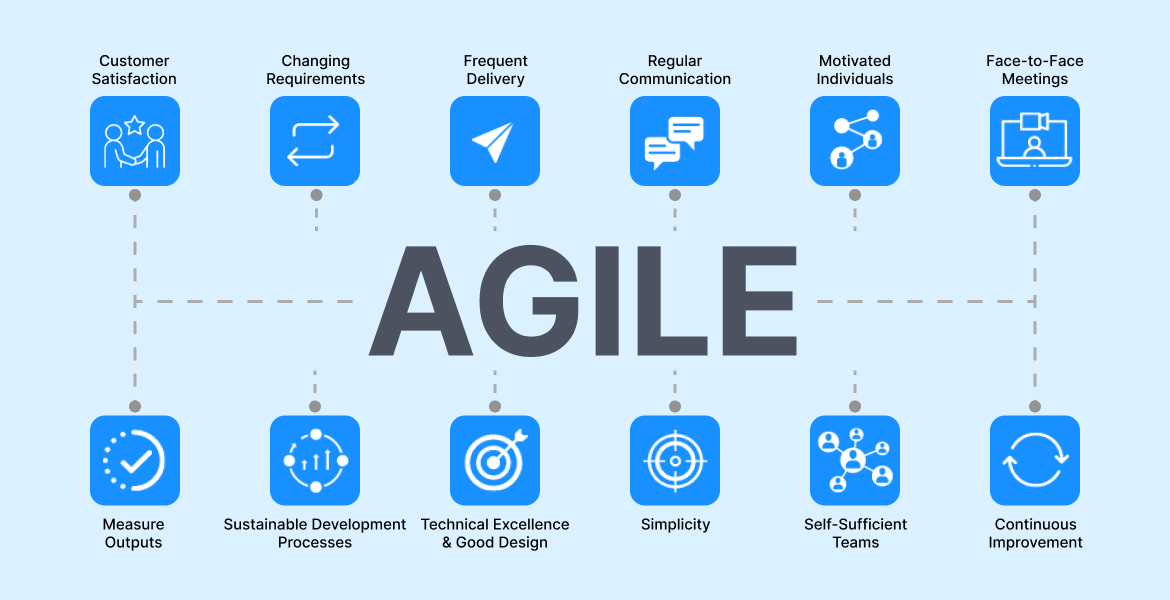
A Complete Guide for Project Managers, Scrum Masters & Development Teams in 2026
Why Agile Principles Still Matter in 2026
Agile methodology isn't just a buzzword — it's the operating system behind the world's most successful software teams.
First formalized in the 2001 Agile Manifesto by 17 software pioneers, the framework's 12 core principles have guided over a million teams across industries ranging from tech startups to Fortune 500 enterprises. In 2026, as AI-assisted development, distributed workforces, and accelerated release cycles reshape how we build products, these principles haven't become obsolete — they've become more critical than ever.
This comprehensive guide breaks down each of the 12 Agile principles, explains what they mean in today's context, and shows you exactly how to apply them to deliver faster, build better products, and keep your customers genuinely happy.
What Is Agile Methodology?
Agile is an iterative, collaborative approach to project management and software development. Unlike traditional Waterfall models that plan everything upfront, Agile breaks work into short cycles (called sprints or iterations), continuously delivers working software, and adapts to change based on real feedback.
The Agile Manifesto established four core values:
- Individuals and interactions over processes and tools
- Working software over comprehensive documentation
- Customer collaboration over contract negotiation
- Responding to change over following a plan
These values are operationalized through the 12 principles below — each one a specific behavioral guideline for how teams should think, act, and deliver.
The 12 Principles of Agile Methodology — Fully Explained
Principles 1–3: Customer & Delivery Focus
Principle 1: Customer Satisfaction Through Early & Continuous Delivery
"Our highest priority is to satisfy the customer through early and continuous delivery of valuable software."
In 2026 terms: ship fast, ship often, and ship value. Whether you're releasing a mobile app feature or deploying an internal tool, the goal is to get real working functionality into users' hands as soon as possible — not wait for a "perfect" big-bang launch. Teams using CI/CD pipelines and feature flags have made this principle standard practice.
Principle 2: Welcome Changing Requirements — Even Late
"Welcome changing requirements, even late in development. Agile processes harness change for the customer's competitive advantage."
Change isn't failure — it's intelligence. When a customer or market shifts, the ability to pivot a backlog without catastrophic rework is a competitive superpower. In 2026, with AI tools generating real-time user insights, teams that treat late-stage changes as data rather than disruption consistently outperform rigid competitors.
Principle 3: Deliver Working Software Frequently
"Deliver working software frequently, from a couple of weeks to a couple of months, with a preference for the shorter timescale."
Short delivery cycles reduce risk, enable faster feedback loops, and keep stakeholders engaged. Most modern Agile teams run 1–2 week sprints. The principle isn't about speed for its own sake — it's about creating multiple checkpoints to course-correct before problems compound.
Principles 4–6: Collaboration & Communication
Principle 4: Business & Developers Must Work Together Daily
"Business people and developers must work together daily throughout the project."
Silos kill Agile. When product managers, engineers, and business stakeholders operate in isolation, misalignment multiplies. Daily stand-ups, shared Kanban boards, and real-time communication tools (Slack, Notion, Linear) are the 2026 expressions of this principle. The goal is zero-latency feedback between those who define value and those who build it.
Principle 5: Build Projects Around Motivated Individuals
"Build projects around motivated individuals. Give them the environment and support they need, and trust them to get the job done."
Autonomy drives performance. Micromanagement and process-heavy bureaucracy are the antithesis of Principle 5. High-performing Agile teams in 2026 are given clear outcomes (not tasks), proper tooling, psychological safety, and the freedom to self-organize. This principle is why Agile and remote-first teams are natural allies.
Principle 6: Face-to-Face Communication Is the Most Effective
"The most efficient and effective method of conveying information is face-to-face conversation."
Originally written for co-located teams, this principle has evolved for 2026's hybrid and remote environments. The spirit remains: high-bandwidth, low-latency communication wins. Async documentation, video calls, and shared virtual workspaces are the modern equivalent. The principle warns against low-signal communication like endless email threads or ticket-only collaboration.
Principles 7–9: Technical Excellence & Progress Measurement
Principle 7: Working Software Is the Primary Measure of Progress
"Working software is the primary measure of progress."
Decks, documentation, and burn-down charts are useful — but none of them deliver value to users. In 2026, this principle challenges teams to prioritize deployable functionality over administrative artifacts ruthlessly. If a sprint ends with 50 slides and zero shipped features, progress hasn't been made.
Principle 8: Agile Processes Promote Sustainable Development
"Agile processes promote sustainable development. The sponsors, developers, and users should be able to maintain a constant pace indefinitely."
Burnout is anti-Agile. The sustainable pace principle guards against "hero culture" — the expectation that teams sprint at 150% indefinitely. Consistent velocity, realistic sprint planning, and protecting developers from scope creep are how modern teams honor Principle 8. Sustainable teams outperform sprint-and-crash teams every time.
Principle 9: Continuous Attention to Technical Excellence
"Continuous attention to technical excellence and good design enhances agility."
Technical debt is the silent Agile killer. When teams skip code reviews, ignore test coverage, or defer refactoring indefinitely, they slow themselves down — the opposite of Agile's intent. In 2026, practices like TDD (Test-Driven Development), automated testing suites, and AI-assisted code review tools make Principle 9 more achievable than ever for teams of any size.
Principles 10–12: Simplicity, Self-Organization & Continuous Improvement
Principle 10: Simplicity — The Art of Maximizing Work Not Done
"Simplicity — the art of maximizing the amount of work not done — is essential."
Build the minimum that delivers maximum value. In 2026, this principle drives MVP thinking, lean roadmaps, and ruthless backlog prioritization. It's not about doing less work — it's about doing the right work. Every feature not built is scope that doesn't become technical debt, maintenance overhead, or user confusion.
Principle 11: The Best Architectures Emerge from Self-Organizing Teams
"The best architectures, requirements, and designs emerge from self-organizing teams."
When talented people are trusted to make decisions closest to the work, better solutions emerge. This principle challenges organizations to distribute decision-making authority to the team level. In 2026's fast-moving tech landscape, teams that wait for top-down architectural approval consistently fall behind those empowered to iterate on their own.
Principle 12: Regular Reflection & Continuous Improvement
"At regular intervals, the team reflects on how to become more effective, then tunes and adjusts its behavior accordingly."
The retrospective is Agile's most powerful ritual. Principle 12 creates a built-in feedback loop at the team level — distinct from product feedback loops. In 2026, high-performing teams run structured retros using frameworks like Start/Stop/Continue, the 4Ls, or Lean Coffee to continuously sharpen their process, remove friction, and protect team health.
Agile Principles Quick Reference Table
| # | Principle | Core Theme | Modern Application |
|---|---|---|---|
| 1 | Early & Continuous Delivery | Customer Value | CI/CD pipelines, feature flags |
| 2 | Welcome Change | Adaptability | Data-driven pivots |
| 3 | Frequent Delivery | Short cycles | 1-2 week sprints |
| 4 | Daily Collaboration | Alignment | Stand-ups, shared boards |
| 5 | Motivated Individuals | Autonomy | Outcome-based team goals |
| 6 | Face-to-Face Communication | High Bandwith | Video-firest async tools |
| 7 | Working Software=Progress | Measurable Output | Deployable increments |
| 8 | Sustainable Pace | Team health | Sprint Capacity planning |
| 9 | Technical Excellence | Code Quality | TDD, AI code review |
| 10 | Simplicity/Less Work | Focus | MVPs, lean roadmaps |
| 11 | Self-Organizing Teams | Empowerment | Distributed decisions |
| 12 | Regular Reflection | Improvement | Sprint Retrospectives |
Frequently Asked Questions
What are the 12 principles of the Agile Manifesto?
The 12 Agile principles cover: early & continuous delivery, welcoming change, frequent delivery, daily business-dev collaboration, motivated individuals, face-to-face communication, working software as progress, sustainable development pace, technical excellence, simplicity, self-organizing teams, and regular team reflection. Together, they operationalize the four Agile values.
Are the 12 Agile principles still relevant in 2026?
Absolutely. While technology has evolved, the human and organizational challenges Agile principles address — communication gaps, unclear priorities, scope creep, and technical debt — remain as present as ever. In 2026, they're applied through modern tools like AI-assisted development, remote collaboration platforms, and continuous delivery pipelines.
What's the difference between Agile principles and Agile frameworks?
Agile principles are guidelines from the Manifesto — the 'why' behind how teams should work. Agile frameworks like Scrum, Kanban, SAFe, and XP are structured implementations — the 'how.' Frameworks are built on top of the principles, not replacements for them.
Which Agile principle is most important?
While all 12 are interconnected, Principle 1 (customer satisfaction through early delivery) and Principle 12 (continuous reflection and improvement) are often cited as foundational. Without customer focus, there's no purpose; without reflection, there's no growth.
Can non-software teams use Agile principles?
Yes — and increasingly they do. Marketing teams, HR departments, design agencies, and operations teams all apply Agile principles. The framework's core ideas around iteration, feedback, and collaboration translate well beyond software development, particularly in environments where requirements change frequently.
How long does it take to implement Agile principles?
Teams can begin practicing core Agile principles (like daily stand-ups, sprint planning, and retrospectives) within 1–2 weeks. Cultural adoption — truly embracing change, trust, and self-organization — typically takes 3–6 months of consistent practice and coaching.
Conclusion: Agile Principles as a Competitive Advantage in 2026
The 12 principles of Agile methodology aren't rules imposed from above — they're a collective philosophy shaped by decades of real-world software development experience. In 2026, they serve as both a compass and a yardstick: a compass for decision-making when processes get complex, and a yardstick for assessing whether your team is truly Agile or just Agile in name.
The teams outperforming their competitors today aren't the ones with the most sophisticated tools or the largest budgets. They're the ones who've genuinely internalized these principles — who deliver value continuously, adapt without panic, communicate without silos, and reflect without ego.
Start with one principle, build the habit, then stack the next.
Need help implementing Agile in your team? Schedule a free 15-minute strategy call with our experts and get clear, actionable insights.
Related Blogs
Schedule a 15-Minutes call
Let’s make things happen and take the first step toward success!
Got Ideas? We’ve Got The Skills.
Let’s Team Up!
Let’s Team Up!
What Happens Next?
We review your request, contact you, and sign an NDA for confidentiality.
We analyze your needs and create a project proposal with scope, team, time, and cost details.
We schedule a meeting to discuss the offer and finalize the details.
The contract is signed, and we start working on your project immediately.