Agile UI/UX Coordination: Roles, Responsibilities and Best Practices

The requirements under Agile development will not be any different, but when. This will either turn into a nightmare or a chance of the designers of the UI/UX. It lies in the structure of the design process. The product will not be shaky, inconveniencing, and difficult to modify even though the requirements are to be changed as it is planned by a well-planned UI/UX.
Shaping a Reusable Foundation
In Agile as a UI/UX designer, one of the most intelligent things I would do will be to develop default design items, which will be uniform throughout the product. These reusable units which are buttons, input fields, modals, and patterns of navigation are the DNA of the design system.
- They are also useful in time savings as they do not need to rework each time they start off on a sprint.
- They offer a visual homogeneity of the product.
- They make the task of the developers easier because they would not be required to go through the new design repeatedly.
And consider it to be the creation of a design language, which never loses its grammar, but gains it.
Paper to Prototype Drafting Process
In Agile, speed matters. That is why it is better to start with rough drafts and plunge into tools.

Step 1: Paper and pencil, Plus Raw and unrefined test of user flows and positioning of constituents.
Step 2: Low-fidelity wireframes: Finding meaning without thinking of design.
Step 3: Illustrate drafts in working interfaces with the help of Figma prototyping.
It implies that this stratified design suggests that the designs will be tested during the early phases and will be enhanced later during the extensive rework costs will be saved in the long-term.
Case in Point: Ellomed
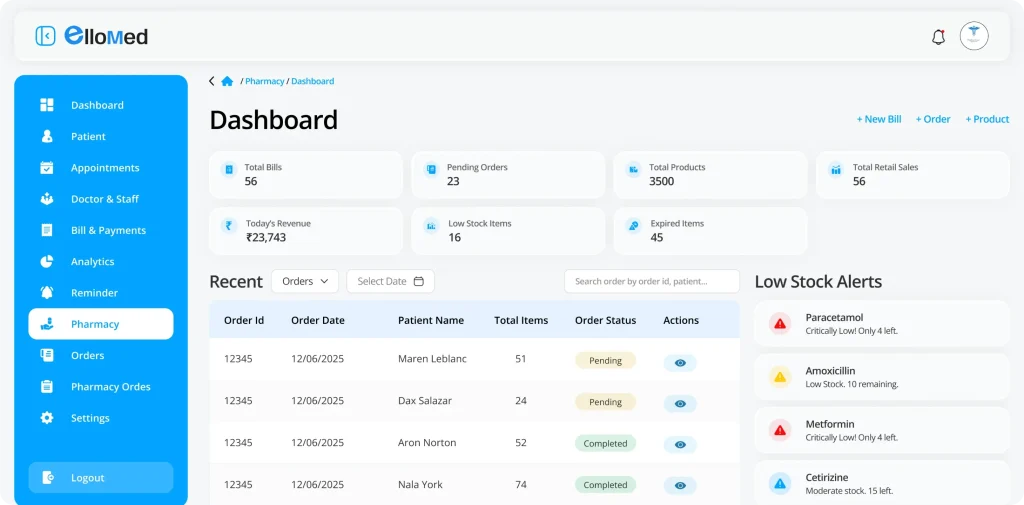
In the case of Ellomed (a system of Electronic Health Records), the project was originally created with a straightforward concept of managing the physicians, clinics, and appointments. However, according to Agile, the requirements continued to be updated, such as pharmacy integration, patient documents, inventory management, etc.
UI/UX coordination helped in keeping the system on track; it did so in the following manner:
- Reusable Components: We specified the standard fields, dashboard cards, buttons, alerts, etc. They did not improve on their components by reusing them when introducing new features. This enhanced the integration as well as productivity of the UI.
- Stability Over Adaptability: The evolving needs did not bring about the destruction of the already existing module but how to insert the other modules and not to completely break down the existing one.
- A good disposition to the user: The designs were all tested on a real user need basis. A case in point is in the pharmacy module where the date of drugs was automatically highlighted in red where it had expired. It was not all that was related to the aesthetic element, but simplifying and accelerating working processes.
Concisely, the need to start afresh was not the foundation of the sound basis of design adaptability.
Ideas of Agile Best Practices of UI/UX Designers
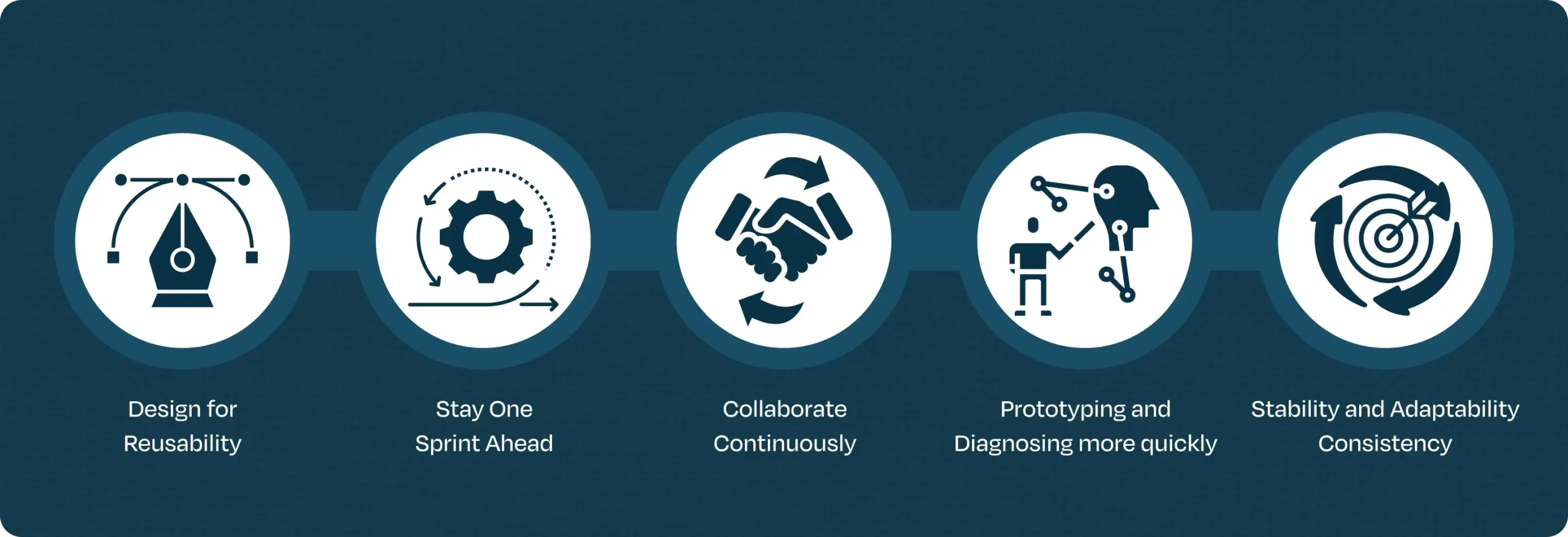
- Design for Reusability: Early analysis of component library. Imagine it to be your LEGO box, you can do anything with it, but the pieces are the same.
- Stay One Sprint Ahead: Plan the next sprint as the current one being developed. This will make sure that it is not rushed.
- Collaborate Continuously: Keep up with BAs, developing and testing. Five minutes talk will save five days of re-work.
- Prototyping and Diagnosing more quickly: The correct moment will never be to wait, to get feedback regarding drafts, and to click prototypes whenever it is possible.
- Stability and Adaptability Consistency: These design principles must be accommodated to cater to the new needs in a non-imposing manner.
Conclusion
Agile does not require the presence of UI/UX coordination in order to make interfaces appealing. It is concerning the way of developing systems that could fit the change and still remain themselves. The designers are able to cope with the challenges that occur due to change of requirements, which they could center on reusable components, draft-first design, and constant teamwork, hence, transform it into an opportunity, rather than a failure.
Practical experience with enterprises indicated that structured UI/UX causes agility to become a natural process – and the final result is not only an efficient system, but also a stable and easy to use system, coupled with being able to survive into the future.
Transform your UI/UX collaboration with Agile best practices. Ellocent Labs offers tailored workshops and hands-on support. Get started now for more efficient, adaptable interfaces.
Related Blogs
When it comes to Agile development, the fact that is to be kept in mind is that change is the only constant. Companies become dynamic because the requirements of users keep on changing. Although such changes may be value addition, as a business analyst one needs to make sure that it does not expose a project to falling off balance. Here is where the Business Analysts come in as they can be viewed as the compass of the ship; making sure that each shift does not cause the project to take the wrong path and the new requirements align with the existing system.
At the beginning of my career, I worked in Ellomed, a system of Electronic Health Records (EHR). The simple idea of assisting clinics and doctors with their appointments and schedules at first turned out to be much bigger. Agile being played, the requirements were evident to be changing at the very beginning. It was not about whether things would change but how to deal with these changes in a better way. The motive was to deliver a quality product at the end of the day.
Building a Solid Foundation
In ElloMed, the first move was to establish a non-negotiable basis, the features that would not be affected by anything.
This anchor made certain that the core will not shake in case of later additions of improvements or even new modules. By obtaining this base, we gained flexibility, but not stability through out the process.
Fact: In Agile projects, a solid base minimises the rework whereby core modules are not redesigned each time there is a requirement change. The whole point in agile is about flexibility to modify the system as per the frequent requirements.
Pharmacy Energizing
One of the biggest changes occurred when there was the integration of pharmacy. It appeared to be another feature at first sight. However, my study found out that there were more serious problems with the current pharmacy systems:

- Inventory was to be checked by manually checking the medicines and other items.
- Out of date products were not marked automatically that indicates lack of expiry management
- Interfaces were not user friendly and looked out dated.
In the case of BAs, the issue at hand was to transform a general request, such as make pharmacy easy to manage, into specific and practical requirements.
Our Approach:
- Gap Analysis- Uncovered inefficiencies in existing systems.
- Competitor Research- Research on tools available of strengths and weaknesses.
- User-Centered design- What pharmacists and staff really needed that can help in making the pharmacy management easier.
The Solution:
We introduced a full-fledged and user-friendly interface designed specifically for pharmacists- one that covered every loophole we had identified during analysis phase.
- Efficient expiry management with automatic alerts and red highlights for expired products
- Managed inventory and order controls that minimized effort and errors.
- An intuitive design that made day-to-day tasks quicker, simpler and far more efficient.
What seemed like a dramatic requirement shift didn’t create disruption because the foundation of ElloMed was already strong, this enhancement only elevated the system transforming it into a tool that was not just functional but genuinely easy and efficient for users.
How BAs Maintain the timelines of projects in case of requirements shifts
ElloMed showed that requirement changes do not necessarily cause consternation. BAs will be in a position to facilitate smooth transitions, with the correct practices that are considered from the very starting of the project.

Here’s how:
- Priorities: Segregate the requirements based on must-haves” vs “nice-to-haves” early on.
- Impact Assessment: This is categorized as an evaluation of the impact of a new change on existing modules before development commences in order to make sure that every new requirement aligns with the existing system and does not break the ongoing flow.
- Documentation: Have a clear record of all requirements, the reason behind its change and the person that authorized the change. This way we can track the record of frequent requirement change.
- Prototyping: Prototyping allows you to check the ideas first by using quick wireframes before starting to design and code them. This is one of the most time saving processes.
- Requirement Alignment: Frequent sprint reviews and requirement check-ins ensure that all are on track. Here, communication is the key to ensure that everyone on the team is on the same page of understanding.
Smart Tips for Agile BAs
The thing is that in Agile it is not only about the process but it is about the way of thinking. Handling dynamic requirements is like sailing in a changing wind; you cannot control the wind, but you can move the sails. A few tips that I found helpful are:
- Sort wheat and chaff apart → Figure out the must-have and nice-to-have list early in life.
- Keep the pulse alive → Have a living history of changes and business value.
- Big bites, small impact → Dividend large requirements into smaller deliverable units.
- Three heads are more than one → Rapidly converge to Three Amigos strategy (BA + Dev + QA).
- Trace back to purpose → It is always important to have changes being linked to the larger business objective.
Lessons from Ellomed
Ellomed was not only a project but more of an Agile classroom. Here’s what it taught me:
- The magic ingredients are patience → Agile succeeds where you allow flexibility of its time. The presence of strong roots, the constant growth, therefore, results in the minimization of chaos in case of the change in requirements.
- Clarity is power → Divide the amorphous thoughts into clear, testable, implementable solutions.
- Make lemons into lemonade → Requirement shifts but the embraced requirement shifts can make the product even stronger.
Conclusion
Requirement changes are not a roadblock in Agile, rather a detour that can get to the destination provided that they are managed properly. It is the way the wheel is turned by BAs.
Business Analysts are the stabilizers of the ship- when there are alterations in directions they are the people who see to it that the project does not head in the wrong direction.
The ideal example is Ellomed: initially a functional scheduling program, it has developed into a highly reputed EHR that has smart pharmacy integration. This was because requirements changes were not feared but leveraged.
As it is said, the strongest or the smartest do not survive, but the most adaptable one. Having the appropriate BA practices such as building the foundation, prioritization and flexibility, the projects do not only remain on track but also emerge as solutions that count.
Facing shifting requirements in your Agile projects? Ellocent Labs expert Business Analysts specialize in impact assessments, prioritization frameworks, and prototyping strategies to keep your projects on track. Contact us today to ensure seamless project delivery.
The online world is always changing, and 2025 is a big year for how businesses get found on search engines. You might hear some people say, “SEO is dead,” but that’s not true at all! Instead, SEO is simply growing and changing, mostly because of Artificial Intelligence (AI) in search. This isn’t a problem; it’s a huge chance for those who are ready to learn and adapt. Google isn’t just counting keywords anymore; it’s looking at how good your content is, what it means, and how easy it is for people to use.
To do well in this new world, businesses need to go beyond old SEO tricks. They need to use a smarter, more connected way of thinking. This means understanding and combining four key ideas: AI Optimization (AIO), Generative Engine Optimization (GEO), Answer Engine Optimization (AEO), and Search Experience Optimization (SXO). These techniques, when used together, are vital for keeping your company prominent and competitive online.
The traditional notion of simply “ranking” high is evolving. Today, it’s more a question of “being the answer” or “being mentioned” by machines. This implies that success is no longer merely the click on a blue link. It is about being the authoritative source that a machine mentions. This alters the manner in which companies define success and strategize their content.
Understanding the New SEO Terms

Let’s break down these new terms to see how they fit into the future of SEO.
AIO: AI Optimization
Making your website’s content simple for AI-driven search engines to comprehend and summarize is the main goal of AI Optimization (AIO). Consider it a way to make your material “machine-readable.” Google’s AI Overviews, which provide instant responses directly on the search page, are expanding. This suggests that fewer people might visit your website. However, Google is making these AI Overviews more link-rich, so even if your website is small, it will still be seen. Getting your brand recognized and highlighted in these AI summaries is now the primary goal, rather than simply generating clicks.
GEO: Generative Engine Optimization
Generative Engine Optimization (GEO) is all about creating your content in such a high quality that AI tools like Google’s Search Generative Experience (SGE) prefer to use it when they generate their answers. It’s all about being the go-to source that AI quotes or mentions. Unlike classical SEO, which desires a click, GEO desires your content to be “the answer” itself. This is to say that your content must be extremely clear, credible, and display actual expertise. AI adores unique insights, original research, and facts that it simply can’t manufacture on its own.
AEO: Answer Engine Optimization
Answer Engine Optimization (AEO) focuses on making your content give direct, short answers to people’s questions. This helps your content show up in “featured snippets” (those quick answer boxes at the top of Google), “People Also Ask” sections, and especially in voice search results. With devices like Alexa and Siri, people get spoken answers without seeing website links. So, being the main source for an answer engine not only makes you more visible but also shows your brand as a trusted expert. AEO means using natural language and answering questions directly, often in a Q&A style.
SXO: Search Experience Optimization
Search Experience Optimization (SXO) involves marrying traditional SEO with the way users really behave on your site (User Experience or UX). Its primary purpose is ensuring that after finding your site, users have an easy, quick, and pleasant time. If your website is slow to load or difficult to navigate on mobile, users will leave quickly, regardless of your search ranking. SXO ensures your site is engaging and user-friendly, helping to keep visitors and encouraging actions like sign-ups and purchases.
How They Work Together for Maximum Impact
The real power of these four strategies lies in their combined use. They are not separate ideas; they work hand-in-hand to make each other stronger.
- AIO lays the groundwork by making your content easy for AI to understand.
- Then, GEO uses that understanding to get your content mentioned and quoted by AI.
- AEO builds on this by making your content appear as direct answers in search results and voice searches.
- Finally, SXO ensures that when people visit your site, they have a great experience, which encourages them to stay and convert.
This creates a positive cycle: good content that AI understands leads to more mentions, which leads to more direct answers, and a great website experience keeps people happy and coming back. This combined approach helps your brand be seen and trusted everywhere online, not just in traditional search results.

Simple Steps to Get Started
To use these strategies, focus on quality, what users want, and a good technical setup:
- Create Great Content:
- Be an Expert: Show your experience, knowledge, and trustworthiness. Mention your sources and have real experts write your content.
- Keep it Clear and Short: Structure your content with clear headings, bullet points, and Q&A sections so AI can easily pull out answers.
- Use Schema Markup: This is like giving AI a map of your content, helping it understand what your page is about.
- Think Like a Human: Use natural, conversational language, especially for voice search.
- Make Your Website Fast and Easy to Use:
- Speed Matters: Make sure your website loads super fast on all devices, especially phones.
- Easy to Navigate: Design your website so people can easily find what they’re looking for.
- Engaging Visuals: Use good images, videos, and charts to make your content more interesting.
- Build Trust and Authority:
- Become a Go-To Source: Create lots of detailed content on your topic to show you’re an expert.
- Get Good Links: Get links from other trusted websites.
- Local SEO: If you have a physical business, make sure your Google Business Profile is updated and get local reviews.
Looking Ahead
The world of SEO is always changing, but human expertise is still key. AI tools can help with research and content ideas, but real creativity, unique ideas, and building trust still come from people. The future of SEO is exciting, and by embracing these new, connected strategies, your business can stay ahead and truly shine online.
Advanced artificial intelligence gives autonomous systems their AI agent operation capabilities. These agents differ from standard chatbots because they execute advanced jobs while gaining understanding from user conversations, then respond independently in new situations without extensive human assistance. A thorough examination of AI agents explains their impact on websites together with the wider market.
Understanding AI Agents
AI agents represent the modern version of AI technology through which they integrate these features:
- Machine Learning: It allows systems to enhance their abilities through continuous learning operations.
- Natural Language Understanding (NLU): The system with Natural Language Understanding (NLU) efficiently processes difficult content while simulating human response capabilities.
- Autonomous Decision-Making: These systems operate independently for the achievement of specified targets through autonomous decision-making processes.
AI agents provide businesses with flexibility for executing various tasks, which include customer service and data analysis, making them a valuable tool for companies.
How AI Agents Are Revolutionizing Websites
- Enhanced User Experiences AI agents provide personalized, intuitive interactions that engage users. For example:
- Automation of Routine Tasks Websites integrated with AI agents can automate repetitive tasks such as:
- Booking appointments
- Managing customer inquiries
- Processing transactions
- This not only saves time but also ensures consistent service quality.
- Advanced Analytics and Insights AI agents can collect and analyze user data to:
- Identify trends and patterns
- Offer actionable insights for website optimization
- Predict user needs to improve engagement and conversions
The Impact on Today’s Market
- Improved Efficiency and Scalability AI agents help businesses achieve operational expansion at increased efficiency levels. Organizations deploy AI agents across their e-commerce platforms together with financial services to achieve effective operations at extensive levels.
- Increased Revenue Opportunities AI agents boost revenue opportunities through their ability to create personalized experiences and handle automated sales, which results in increased conversions while satisfying customers.
- Competitive Advantage Organizations that use AI agents first achieve substantial competitive value by giving their customers advanced solutions with premium experiences, thereby differentiating themselves in market competition.

The Future of AI Agents in Websites and Markets
AI technology development will result in AI agents acquiring the following capabilities:
- Become More Intuitive: The ability to sense user emotions and contextual understanding will become better.
- Expand Across Industries: AI agents will demonstrate increasing importance in managing all business sectors, starting from healthcare right through to entertainment.
- Drive Hyper-Personalization: Every user interaction will become personalized according to individual preferences through Drive Hyper-Personalization.
Final Thoughts
AI agents have moved from future potential to current reality because they now change website behavior and the manner businesses interact with their customers. AI agents help companies optimize their operations while improving customer experiences to achieve better market position in the fast-moving industry.
At Ellocent Labs, we specialize in integrating AI agents into websites and digital platforms. Let us help you unlock the full potential of AI for your business.
Contact us today to learn more about AI solutions tailored to your needs.
Generative AI vs Traditional AI: Which is Right for Your Business?
Artificial Intelligence (AI) has changed the way companies start innovating, work, and compete. But in 2026, AI will not be a solution to everything. Businesses are now presented with a major choice: they can either go with the new Generative AI, the up-and-coming technology responsible for ChatGPT and DALL·E, or keep using Traditional AI, the established technology that drives recommendation systems, fraud detection, and predictive analytics.
The two categories of AI address various issues and present different values. In this article, we will break down the differences, conduct a cost-benefit analysis, and help you make an informed decision on which one best fits your business.
What is Traditional AI?
Traditional AI focuses on pattern recognition, classification, and prediction based on structured information and rule-based systems. It uses past data to learn and make right predictions within a clear scope.
Key Features:
- Works with structured data (numbers, labels, historical records)
- Rule-based algorithms and statistical models
- Great for predictive analytics, optimization, and classification
- Requires domain-specific data preparation and training
Examples in Business
- Works with structured data (numbers, labels, historical records)
- Rule-based algorithms and statistical models
- Great for predictive analytics, optimization, and classification
- Requires domain-specific data preparation and training

What is Generative AI?
Generative AI uses large-scale machine learning models (like GPT, Stable Diffusion, or Claude) to create new content: text, images, code, audio, and even video. Not only can it find patterns in evidence, but can generate new outputs to feed prompts.
Key Features:
- Works with both structured and unstructured data
- Generates human-like text, images, and media
- Leverages LLMs (Large Language Models) and foundation models
- Enables conversational AI, content creation, and ideation
Examples in Business:
- Chatbots and virtual assistants (customer support)
- Automated content creation (blogs, product descriptions, marketing copy)
- Code generation for faster software development
- Drug discovery and molecule design in healthcare
Cost-Benefit Analysis (2026 Outlook)
1. Development Cost & Resources
- Traditional AI: Less specialized data, less infrastructure, and smaller models are required. Less expensive to implement and limited in scope.
- Generative AI: High upfront costs (LLM training/integration, GPUs, APIs). However, pre-trained models (OpenAI, Anthropic, Hugging Face) lower the barrier.
Choose Traditional AI if your goal is efficiency.
Generative AI should be used in cases of innovation and involvement.
2. Speed of Deployment
- Traditional AI: Faster deployment for predictive use cases with structured data.
- Generative AI: APIs can be readily integrated quickly (pre-trained), although more fine-tuning is required to support enterprise-specific applications.
Traditional AI: best for companies with structured historical data.
Generative AI: best for companies seeking customer-facing apps.
3. Scalability & Flexibility
- Traditional AI: Scales well in the limited scope it is used in but cannot handle unstructured data.
- Generative AI: Scales across departments—from HR (resume screening bots) to marketing (ad generation).
📌 Example: A demand forecasting done by the traditional AI can be used by an e-commerce company but the other AI-based applications can be implemented through generative AI, AI-based product description and chatbots.
4. Accuracy vs Creativity
- Traditional AI: Prioritizes accuracy, rules, and deterministic outputs.
- Generative AI: Will focus on creative and contextual generation, but can give hallucinations (plausible but false result).
Use Traditional AI where accuracy is important (finance, healthcare).
Use Generative AI where creativity and engagement matter (marketing, product design).
5. Security & Compliance
- Traditional AI: This type of AI is simpler to manage because it is based on structured data the company owns.
- Generative AI: poses a threat to intellectual property, data privacy, and bias. Needs a more governing force.
📌 Example: A hospital can implement traditional AI to support diagnosis and pilot generative AI to implement patient communicators.
Where Traditional AI Wins in 2026
- Fraud detection & risk scoring in fintech
- Predictive analytics for sales & operations
- Quality control in manufacturing
- Supply chain demand forecasting
- Any use case requiring high accuracy & low tolerance for errors
Where Generative AI Wins in 2026
- AI-powered customer service (chatbots, virtual assistants)
- Personalized campaigns (ad copy, automation of marketing)
- Content generation (blogs, reports, social media posts)
- Product design/innovation (prototyping, ideation)
- Healthcare R&D (drug discovery, patient education tools)
The Hybrid Approach: Generative + Traditional AI
Forward-thinking businesses don’t see this as an either/or choice. They would rather combine the two methods to use the best.
Example:
- A bank can apply traditional AI to fraud detection.
- Generative AI can also be applied by the same bank to generate individual customer financial advice reports.
Together, they provide accuracy + engagement.
Decision-Making Framework: Which AI is Right for Your Business?
Ask these questions before deciding:
- What problem are we solving — prediction or creation?
- Do we work primarily with structured or unstructured data?
- Is accuracy or creativity more important?
- How much money do we have to spend on AI infrastructure and APIs?
- Are we ready to have governance, compliance and ethical issues?
- Pick Traditional AI → are efficiency, accuracy, and predictive insights your business drivers.
- Pick Generative AI → if engagement, personalization, and innovation matter most.
- Pick Both → if you want a long-term AI strategy.
Conclusion
In 2026, businesses no longer ask whether to adopt AI but which type of AI is right for them. Traditional AI remains the backbone of predictive analytics and operational efficiency, while Generative AI is rewriting the rules of creativity, customer engagement, and automation.
The smartest organizations will adopt a hybrid AI strategy—leveraging traditional AI for accuracy and optimization while harnessing generative AI for innovation and differentiation.
By 2026, the question of whether a business should embrace AI is a thing of the past, but every business is asked what type of AI fits them. Generative AI is a complete rewrite of the rules of creativity, customer engagement, and automation, but traditional AI is still the foundation of predictive analytics and operational efficiency.
The most intelligent organizations will pursue a hybrid approach to AI use, combining traditional AI with precision and efficiency and generative AI with innovation and differentiation.
How Business Analysts Keep Projects on Track When Requirements Shift
When it comes to Agile development, the fact that is to be kept in mind is that change is the only constant. Companies become dynamic because the requirements of users keep on changing. Although such changes may be value addition, as a business analyst one needs to make sure that it does not expose a project to falling off balance. Here is where the Business Analysts come in as they can be viewed as the compass of the ship; making sure that each shift does not cause the project to take the wrong path and the new requirements align with the existing system.
At the beginning of my career, I worked in Ellomed, a system of Electronic Health Records (EHR). The simple idea of assisting clinics and doctors with their appointments and schedules at first turned out to be much bigger. Agile being played, the requirements were evident to be changing at the very beginning. It was not about whether things would change but how to deal with these changes in a better way. The motive was to deliver a quality product at the end of the day.
Building a Solid Foundation
In ElloMed, the first move was to establish a non-negotiable basis, the features that would not be affected by anything.
This anchor made certain that the core will not shake in case of later additions of improvements or even new modules. By obtaining this base, we gained flexibility, but not stability through out the process.
Fact: In Agile projects, a solid base minimises the rework whereby core modules are not redesigned each time there is a requirement change. The whole point in agile is about flexibility to modify the system as per the frequent requirements.
Pharmacy Energizing
One of the biggest changes occurred when there was the integration of pharmacy. It appeared to be another feature at first sight. However, my study found out that there were more serious problems with the current pharmacy systems:

- Inventory was to be checked by manually checking the medicines and other items.
- Out of date products were not marked automatically that indicates lack of expiry management
- Interfaces were not user friendly and looked out dated.
In the case of BAs, the issue at hand was to transform a general request, such as make pharmacy easy to manage, into specific and practical requirements.
Our Approach:
- Gap Analysis- Uncovered inefficiencies in existing systems.
- Competitor Research- Research on tools available of strengths and weaknesses.
- User-Centered design- What pharmacists and staff really needed that can help in making the pharmacy management easier.
The Solution:
We introduced a full-fledged and user-friendly interface designed specifically for pharmacists- one that covered every loophole we had identified during analysis phase.
- Efficient expiry management with automatic alerts and red highlights for expired products
- Managed inventory and order controls that minimized effort and errors.
- An intuitive design that made day-to-day tasks quicker, simpler and far more efficient.
What seemed like a dramatic requirement shift didn’t create disruption because the foundation of ElloMed was already strong, this enhancement only elevated the system transforming it into a tool that was not just functional but genuinely easy and efficient for users.
How BAs Maintain the timelines of projects in case of requirements shifts
ElloMed showed that requirement changes do not necessarily cause consternation. BAs will be in a position to facilitate smooth transitions, with the correct practices that are considered from the very starting of the project.

Here’s how:
- Priorities: Segregate the requirements based on must-haves” vs “nice-to-haves” early on.
- Impact Assessment: This is categorized as an evaluation of the impact of a new change on existing modules before development commences in order to make sure that every new requirement aligns with the existing system and does not break the ongoing flow.
- Documentation: Have a clear record of all requirements, the reason behind its change and the person that authorized the change. This way we can track the record of frequent requirement change.
- Prototyping: Prototyping allows you to check the ideas first by using quick wireframes before starting to design and code them. This is one of the most time saving processes.
- Requirement Alignment: Frequent sprint reviews and requirement check-ins ensure that all are on track. Here, communication is the key to ensure that everyone on the team is on the same page of understanding.
Smart Tips for Agile BAs
The thing is that in Agile it is not only about the process but it is about the way of thinking. Handling dynamic requirements is like sailing in a changing wind; you cannot control the wind, but you can move the sails. A few tips that I found helpful are:
- Sort wheat and chaff apart → Figure out the must-have and nice-to-have list early in life.
- Keep the pulse alive → Have a living history of changes and business value.
- Big bites, small impact → Dividend large requirements into smaller deliverable units.
- Three heads are more than one → Rapidly converge to Three Amigos strategy (BA + Dev + QA).
- Trace back to purpose → It is always important to have changes being linked to the larger business objective.
Lessons from Ellomed
Ellomed was not only a project but more of an Agile classroom. Here’s what it taught me:
- The magic ingredients are patience → Agile succeeds where you allow flexibility of its time. The presence of strong roots, the constant growth, therefore, results in the minimization of chaos in case of the change in requirements.
- Clarity is power → Divide the amorphous thoughts into clear, testable, implementable solutions.
- Make lemons into lemonade → Requirement shifts but the embraced requirement shifts can make the product even stronger.
Conclusion
Requirement changes are not a roadblock in Agile, rather a detour that can get to the destination provided that they are managed properly. It is the way the wheel is turned by BAs.
Business Analysts are the stabilizers of the ship- when there are alterations in directions they are the people who see to it that the project does not head in the wrong direction.
The ideal example is Ellomed: initially a functional scheduling program, it has developed into a highly reputed EHR that has smart pharmacy integration. This was because requirements changes were not feared but leveraged.
As it is said, the strongest or the smartest do not survive, but the most adaptable one. Having the appropriate BA practices such as building the foundation, prioritization and flexibility, the projects do not only remain on track but also emerge as solutions that count.
Facing shifting requirements in your Agile projects? Ellocent Labs expert Business Analysts specialize in impact assessments, prioritization frameworks, and prototyping strategies to keep your projects on track. Contact us today to ensure seamless project delivery.
SEO Trends 2025: Making Your Brand Shine with AIO, GEO, AEO and SXO
The online world is always changing, and 2025 is a big year for how businesses get found on search engines. You might hear some people say, “SEO is dead,” but that’s not true at all! Instead, SEO is simply growing and changing, mostly because of Artificial Intelligence (AI) in search. This isn’t a problem; it’s a huge chance for those who are ready to learn and adapt. Google isn’t just counting keywords anymore; it’s looking at how good your content is, what it means, and how easy it is for people to use.
To do well in this new world, businesses need to go beyond old SEO tricks. They need to use a smarter, more connected way of thinking. This means understanding and combining four key ideas: AI Optimization (AIO), Generative Engine Optimization (GEO), Answer Engine Optimization (AEO), and Search Experience Optimization (SXO). These techniques, when used together, are vital for keeping your company prominent and competitive online.
The traditional notion of simply “ranking” high is evolving. Today, it’s more a question of “being the answer” or “being mentioned” by machines. This implies that success is no longer merely the click on a blue link. It is about being the authoritative source that a machine mentions. This alters the manner in which companies define success and strategize their content.
Understanding the New SEO Terms

Let’s break down these new terms to see how they fit into the future of SEO.
AIO: AI Optimization
Making your website’s content simple for AI-driven search engines to comprehend and summarize is the main goal of AI Optimization (AIO). Consider it a way to make your material “machine-readable.” Google’s AI Overviews, which provide instant responses directly on the search page, are expanding. This suggests that fewer people might visit your website. However, Google is making these AI Overviews more link-rich, so even if your website is small, it will still be seen. Getting your brand recognized and highlighted in these AI summaries is now the primary goal, rather than simply generating clicks.
GEO: Generative Engine Optimization
Generative Engine Optimization (GEO) is all about creating your content in such a high quality that AI tools like Google’s Search Generative Experience (SGE) prefer to use it when they generate their answers. It’s all about being the go-to source that AI quotes or mentions. Unlike classical SEO, which desires a click, GEO desires your content to be “the answer” itself. This is to say that your content must be extremely clear, credible, and display actual expertise. AI adores unique insights, original research, and facts that it simply can’t manufacture on its own.
AEO: Answer Engine Optimization
Answer Engine Optimization (AEO) focuses on making your content give direct, short answers to people’s questions. This helps your content show up in “featured snippets” (those quick answer boxes at the top of Google), “People Also Ask” sections, and especially in voice search results. With devices like Alexa and Siri, people get spoken answers without seeing website links. So, being the main source for an answer engine not only makes you more visible but also shows your brand as a trusted expert. AEO means using natural language and answering questions directly, often in a Q&A style.
SXO: Search Experience Optimization
Search Experience Optimization (SXO) involves marrying traditional SEO with the way users really behave on your site (User Experience or UX). Its primary purpose is ensuring that after finding your site, users have an easy, quick, and pleasant time. If your website is slow to load or difficult to navigate on mobile, users will leave quickly, regardless of your search ranking. SXO ensures your site is engaging and user-friendly, helping to keep visitors and encouraging actions like sign-ups and purchases.
How They Work Together for Maximum Impact
The real power of these four strategies lies in their combined use. They are not separate ideas; they work hand-in-hand to make each other stronger.
- AIO lays the groundwork by making your content easy for AI to understand.
- Then, GEO uses that understanding to get your content mentioned and quoted by AI.
- AEO builds on this by making your content appear as direct answers in search results and voice searches.
- Finally, SXO ensures that when people visit your site, they have a great experience, which encourages them to stay and convert.
This creates a positive cycle: good content that AI understands leads to more mentions, which leads to more direct answers, and a great website experience keeps people happy and coming back. This combined approach helps your brand be seen and trusted everywhere online, not just in traditional search results.

Simple Steps to Get Started
To use these strategies, focus on quality, what users want, and a good technical setup:
- Create Great Content:
- Be an Expert: Show your experience, knowledge, and trustworthiness. Mention your sources and have real experts write your content.
- Keep it Clear and Short: Structure your content with clear headings, bullet points, and Q&A sections so AI can easily pull out answers.
- Use Schema Markup: This is like giving AI a map of your content, helping it understand what your page is about.
- Think Like a Human: Use natural, conversational language, especially for voice search.
- Make Your Website Fast and Easy to Use:
- Speed Matters: Make sure your website loads super fast on all devices, especially phones.
- Easy to Navigate: Design your website so people can easily find what they’re looking for.
- Engaging Visuals: Use good images, videos, and charts to make your content more interesting.
- Build Trust and Authority:
- Become a Go-To Source: Create lots of detailed content on your topic to show you’re an expert.
- Get Good Links: Get links from other trusted websites.
- Local SEO: If you have a physical business, make sure your Google Business Profile is updated and get local reviews.
Looking Ahead
The world of SEO is always changing, but human expertise is still key. AI tools can help with research and content ideas, but real creativity, unique ideas, and building trust still come from people. The future of SEO is exciting, and by embracing these new, connected strategies, your business can stay ahead and truly shine online.
What are AI agents, and How do They Impact Today Market and Websites?
Advanced artificial intelligence gives autonomous systems their AI agent operation capabilities. These agents differ from standard chatbots because they execute advanced jobs while gaining understanding from user conversations, then respond independently in new situations without extensive human assistance. A thorough examination of AI agents explains their impact on websites together with the wider market.
Understanding AI Agents
AI agents represent the modern version of AI technology through which they integrate these features:
- Machine Learning: It allows systems to enhance their abilities through continuous learning operations.
- Natural Language Understanding (NLU): The system with Natural Language Understanding (NLU) efficiently processes difficult content while simulating human response capabilities.
- Autonomous Decision-Making: These systems operate independently for the achievement of specified targets through autonomous decision-making processes.
AI agents provide businesses with flexibility for executing various tasks, which include customer service and data analysis, making them a valuable tool for companies.
How AI Agents Are Revolutionizing Websites
- Enhanced User Experiences AI agents provide personalized, intuitive interactions that engage users. For example:
- Automation of Routine Tasks Websites integrated with AI agents can automate repetitive tasks such as:
- Booking appointments
- Managing customer inquiries
- Processing transactions
- This not only saves time but also ensures consistent service quality.
- Advanced Analytics and Insights AI agents can collect and analyze user data to:
- Identify trends and patterns
- Offer actionable insights for website optimization
- Predict user needs to improve engagement and conversions
The Impact on Today’s Market
- Improved Efficiency and Scalability AI agents help businesses achieve operational expansion at increased efficiency levels. Organizations deploy AI agents across their e-commerce platforms together with financial services to achieve effective operations at extensive levels.
- Increased Revenue Opportunities AI agents boost revenue opportunities through their ability to create personalized experiences and handle automated sales, which results in increased conversions while satisfying customers.
- Competitive Advantage Organizations that use AI agents first achieve substantial competitive value by giving their customers advanced solutions with premium experiences, thereby differentiating themselves in market competition.

The Future of AI Agents in Websites and Markets
AI technology development will result in AI agents acquiring the following capabilities:
- Become More Intuitive: The ability to sense user emotions and contextual understanding will become better.
- Expand Across Industries: AI agents will demonstrate increasing importance in managing all business sectors, starting from healthcare right through to entertainment.
- Drive Hyper-Personalization: Every user interaction will become personalized according to individual preferences through Drive Hyper-Personalization.
Final Thoughts
AI agents have moved from future potential to current reality because they now change website behavior and the manner businesses interact with their customers. AI agents help companies optimize their operations while improving customer experiences to achieve better market position in the fast-moving industry.
At Ellocent Labs, we specialize in integrating AI agents into websites and digital platforms. Let us help you unlock the full potential of AI for your business.
Contact us today to learn more about AI solutions tailored to your needs.
SEO Trends 2025: Making Your Brand Shine with AIO, GEO, AEO and SXO
The online world is always changing, and 2025 is a big year for how businesses get found on search engines. You might hear some people say, “SEO is dead,” but that’s not true at all! Instead, SEO is simply growing and changing, mostly because of Artificial Intelligence (AI) in search. This isn’t a problem; it’s a huge chance for those who are ready to learn and adapt. Google isn’t just counting keywords anymore; it’s looking at how good your content is, what it means, and how easy it is for people to use.
To do well in this new world, businesses need to go beyond old SEO tricks. They need to use a smarter, more connected way of thinking. This means understanding and combining four key ideas: AI Optimization (AIO), Generative Engine Optimization (GEO), Answer Engine Optimization (AEO), and Search Experience Optimization (SXO). These techniques, when used together, are vital for keeping your company prominent and competitive online.
The traditional notion of simply “ranking” high is evolving. Today, it’s more a question of “being the answer” or “being mentioned” by machines. This implies that success is no longer merely the click on a blue link. It is about being the authoritative source that a machine mentions. This alters the manner in which companies define success and strategize their content.
Understanding the New SEO Terms

Let’s break down these new terms to see how they fit into the future of SEO.
AIO: AI Optimization
Making your website’s content simple for AI-driven search engines to comprehend and summarize is the main goal of AI Optimization (AIO). Consider it a way to make your material “machine-readable.” Google’s AI Overviews, which provide instant responses directly on the search page, are expanding. This suggests that fewer people might visit your website. However, Google is making these AI Overviews more link-rich, so even if your website is small, it will still be seen. Getting your brand recognized and highlighted in these AI summaries is now the primary goal, rather than simply generating clicks.
GEO: Generative Engine Optimization
Generative Engine Optimization (GEO) is all about creating your content in such a high quality that AI tools like Google’s Search Generative Experience (SGE) prefer to use it when they generate their answers. It’s all about being the go-to source that AI quotes or mentions. Unlike classical SEO, which desires a click, GEO desires your content to be “the answer” itself. This is to say that your content must be extremely clear, credible, and display actual expertise. AI adores unique insights, original research, and facts that it simply can’t manufacture on its own.
AEO: Answer Engine Optimization
Answer Engine Optimization (AEO) focuses on making your content give direct, short answers to people’s questions. This helps your content show up in “featured snippets” (those quick answer boxes at the top of Google), “People Also Ask” sections, and especially in voice search results. With devices like Alexa and Siri, people get spoken answers without seeing website links. So, being the main source for an answer engine not only makes you more visible but also shows your brand as a trusted expert. AEO means using natural language and answering questions directly, often in a Q&A style.
SXO: Search Experience Optimization
Search Experience Optimization (SXO) involves marrying traditional SEO with the way users really behave on your site (User Experience or UX). Its primary purpose is ensuring that after finding your site, users have an easy, quick, and pleasant time. If your website is slow to load or difficult to navigate on mobile, users will leave quickly, regardless of your search ranking. SXO ensures your site is engaging and user-friendly, helping to keep visitors and encouraging actions like sign-ups and purchases.
How They Work Together for Maximum Impact
The real power of these four strategies lies in their combined use. They are not separate ideas; they work hand-in-hand to make each other stronger.
- AIO lays the groundwork by making your content easy for AI to understand.
- Then, GEO uses that understanding to get your content mentioned and quoted by AI.
- AEO builds on this by making your content appear as direct answers in search results and voice searches.
- Finally, SXO ensures that when people visit your site, they have a great experience, which encourages them to stay and convert.
This creates a positive cycle: good content that AI understands leads to more mentions, which leads to more direct answers, and a great website experience keeps people happy and coming back. This combined approach helps your brand be seen and trusted everywhere online, not just in traditional search results.

Simple Steps to Get Started
To use these strategies, focus on quality, what users want, and a good technical setup:
- Create Great Content:
- Be an Expert: Show your experience, knowledge, and trustworthiness. Mention your sources and have real experts write your content.
- Keep it Clear and Short: Structure your content with clear headings, bullet points, and Q&A sections so AI can easily pull out answers.
- Use Schema Markup: This is like giving AI a map of your content, helping it understand what your page is about.
- Think Like a Human: Use natural, conversational language, especially for voice search.
- Make Your Website Fast and Easy to Use:
- Speed Matters: Make sure your website loads super fast on all devices, especially phones.
- Easy to Navigate: Design your website so people can easily find what they’re looking for.
- Engaging Visuals: Use good images, videos, and charts to make your content more interesting.
- Build Trust and Authority:
- Become a Go-To Source: Create lots of detailed content on your topic to show you’re an expert.
- Get Good Links: Get links from other trusted websites.
- Local SEO: If you have a physical business, make sure your Google Business Profile is updated and get local reviews.
Looking Ahead
The world of SEO is always changing, but human expertise is still key. AI tools can help with research and content ideas, but real creativity, unique ideas, and building trust still come from people. The future of SEO is exciting, and by embracing these new, connected strategies, your business can stay ahead and truly shine online.
Schedule a 15-Minutes call
Let’s make things happen and take the first step toward success!
Got Ideas? We’ve Got The Skills.
Let’s Team Up!
Let’s Team Up!
What Happens Next?
We review your request, contact you, and sign an NDA for confidentiality.
We analyze your needs and create a project proposal with scope, team, time, and cost details.
We schedule a meeting to discuss the offer and finalize the details.
The contract is signed, and we start working on your project immediately.
