Agile Methodology: Principles, Values and How It Works
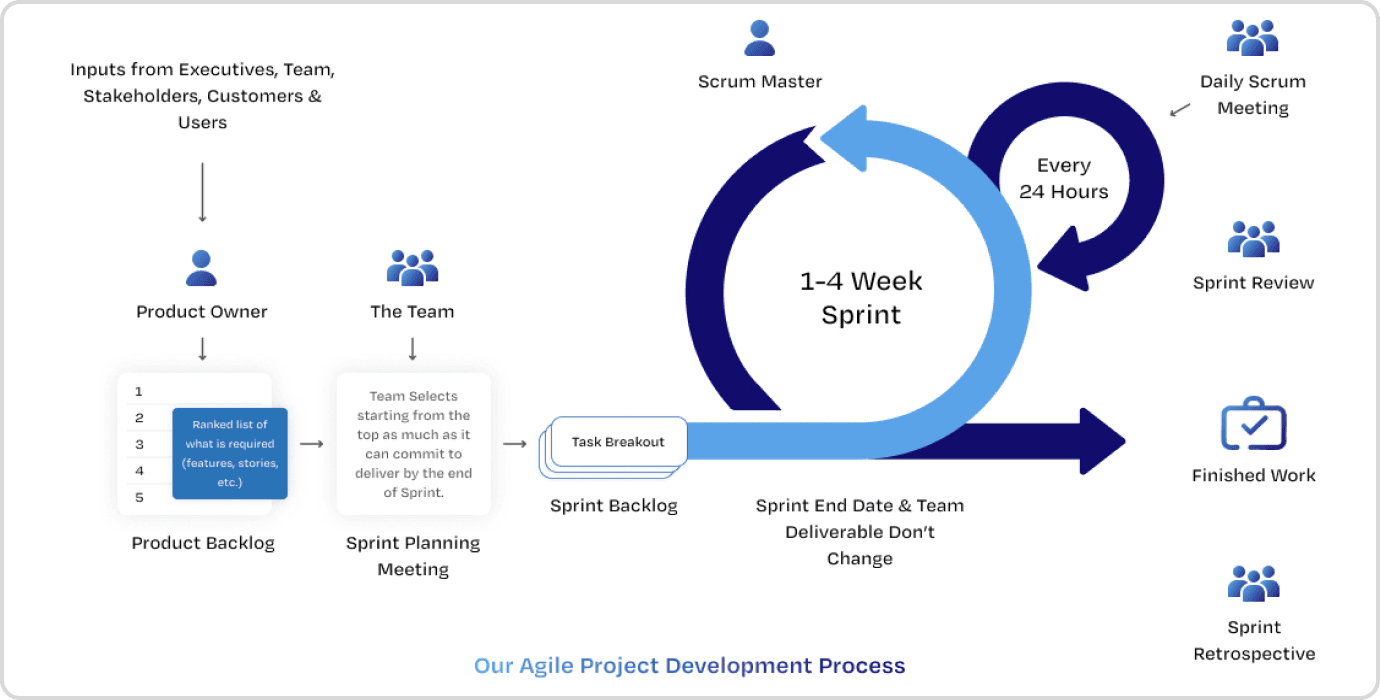
Agile methodology is an iterative way of building software and running projects: work is split into short cycles, each cycle delivers something usable, and the team changes course based on feedback instead of following a fixed long-term plan. It rests on 4 values and 12 principles published in the Agile Manifesto in 2001, and it is put into practice through frameworks such as Scrum and Kanban.
This guide explains the values and principles in plain language, how an agile process runs week to week, how Scrum and Kanban differ, and what it takes to start with a real team.
What is agile methodology?
Agile is an approach, not a single method. In a traditional "waterfall" project, the team gathers every requirement up front, designs the whole system, builds it, then tests it at the end. Problems surface late, when they are expensive to fix.
Agile reverses that. The team plans just enough to start, builds a small working increment in one to four weeks, shows it to users or stakeholders, and uses what it learns to decide what to build next. Requirements are expected to change, so the process is designed to absorb change cheaply.
The 4 agile values
The Agile Manifesto states four values. Each one prefers the item on the left while still recognizing value in the item on the right:
- Individuals and interactions over processes and tools
- Working software over comprehensive documentation
- Customer collaboration over contract negotiation
- Responding to change over following a plan
The values do not say documentation, contracts or plans are bad. They set priorities for when the two sides conflict.
The 12 agile principles, explained simply
The manifesto's 12 principles turn the values into day-to-day behavior. Here they are in plain terms, with what each looks like in practice.
| # | Principle (summarized) | What it looks like in practice |
|---|---|---|
| 1 | Satisfy the customer through early and continuous delivery of valuable software | Release small, usable features often instead of one big launch |
| 2 | Welcome changing requirements, even late | Re-order the backlog when the market or customer changes |
| 3 | Deliver working software frequently, preferring shorter cycles | One- or two-week sprints that end with a demo |
| 4 | Business people and developers work together daily | A product owner who is available to the team every day |
| 5 | Build projects around motivated people and trust them | Give teams outcomes to reach, not task lists to follow |
| 6 | Face-to-face conversation is the most effective communication | Video calls and live working sessions over long email threads |
| 7 | Working software is the primary measure of progress | Track shipped features, not documents produced |
| 8 | Keep a sustainable pace indefinitely | Plan sprints to real capacity; avoid repeated overtime |
| 9 | Continuous attention to technical excellence and good design | Code review, automated tests, regular refactoring |
| 10 | Simplicity: maximize the work not done | Build the smallest version that answers the question |
| 11 | The best designs emerge from self-organizing teams | The team decides how to build; leaders decide what and why |
| 12 | Reflect regularly and adjust | A retrospective at the end of every sprint |
Which agile principles matter most?
All 12 support each other, but teams new to agile usually get the most from three: frequent delivery of working software (principles 1 and 3), daily collaboration with the business (principle 4) and regular reflection (principle 12). Those three create the feedback loop everything else depends on.
The 3 pillars of agile: transparency, inspection, adaptation
Scrum, the most widely used agile framework, describes three pillars in the Scrum Guide. They are often used to describe agile in general:
- Transparency: everyone can see the goal, the backlog and the real state of the work.
- Inspection: the team checks the product and its own process often, at fixed points.
- Adaptation: when inspection shows a problem, the team changes the plan or the process quickly.
How the agile process works, step by step
Most agile teams follow a cycle like this, whatever framework they use:
- Product backlog: a single, ordered list of everything the product might need, owned by the product owner.
- Sprint planning: the team picks the highest-value items it can finish in the next sprint and agrees a sprint goal.
- Daily stand-up: a 15-minute check on progress toward the goal and anything blocking it.
- Build and test: work is designed, coded, reviewed and tested within the sprint, ideally through a CI/CD pipeline.
- Sprint review: the team demonstrates working software and collects feedback.
- Retrospective: the team discusses what to keep, stop and change in how it works.
- Backlog refinement: feedback is turned into new or re-ordered backlog items, and the cycle repeats.
Agile frameworks: Scrum vs Kanban vs others
| Framework | How work flows | Best for |
|---|---|---|
| Scrum | Fixed-length sprints with set roles (product owner, Scrum master, developers) and events | Product teams building new features with a clear owner |
| Kanban | Continuous flow on a visual board with limits on work in progress | Support, operations and teams with unpredictable incoming work |
| Extreme Programming (XP) | Short cycles plus engineering practices such as pair programming and test-driven development | Teams that want agile engineering discipline, not just planning |
| Scaled frameworks (SAFe, LeSS) | Coordinate many agile teams around shared planning | Large organizations with many teams on one product |
Benefits and limits of agile
Benefits: earlier feedback, less wasted work, visible progress, the ability to change priorities without restarting, and teams that improve their own process over time.
Limits: agile needs an engaged product owner and stakeholders who will review work every sprint. Fixed-scope, fixed-price contracts fit it poorly unless scope is allowed to flex. And "agile" without engineering discipline (testing, code review, automation) quickly produces fast-moving technical debt.
How to start using agile with your team
- Pick one team and one product, not the whole organization.
- Name a product owner who can make priority calls every week.
- Build a backlog of outcomes, ordered by value.
- Run two-week sprints with a review and a retrospective every time.
- Automate builds and tests early so frequent delivery stays safe.
- After three or four sprints, use the retrospectives to adjust the process.
At Ellocent Labs we run client projects in short sprints with demos at the end of each one, timed so clients in different time zones can join. You can see how we work on our agile delivery page.
Frequently asked questions
What is agile methodology in simple terms?
Building in small steps, getting feedback after each step, and changing the plan based on what you learn.
What are the 12 principles of agile?
Early and continuous delivery, welcoming change, frequent delivery, daily business-developer collaboration, motivated and trusted people, face-to-face communication, working software as the measure of progress, sustainable pace, technical excellence, simplicity, self-organizing teams and regular reflection.
What is the difference between agile and Scrum?
Agile is the set of values and principles. Scrum is one framework that puts them into practice with specific roles, events and artifacts.
Is agile only for software teams?
No. Marketing, operations and product teams use agile practices, especially Kanban, wherever work changes often and benefits from quick feedback.
How long does it take to adopt agile?
A team can run its first sprint within a couple of weeks. Changing habits such as trusting the team and accepting changing scope usually takes several months of consistent practice.
Need an agile development partner?
If you want a team that ships working software every sprint and shows you progress you can test, book a discovery call with our engineers.
Not sure which approach is right for your project?
We've built both. We'll tell you honestly which one fits.
From no-code MVPs validated in 6 weeks to enterprise AI platforms with 50,000+ users, we've built across the whole range. Book a consultation and we'll tell you honestly which approach fits your budget, your timeline, and your scale ambitions.
Book a discovery call