Investor Relations Software for ASX-Listed Companies

Listen to this article
ASX-listed companies can automate much of their investor relations work, including announcements, registry data, shareholder communication and reporting-season load, as long as nothing can reach the market unreviewed. Three design choices matter most: a separate database for each company, a human approval step on every announcement, and an audit record the application cannot edit.
From the outside, investor relations looks like email and PDFs. Inside a listed company it is a deadline-driven, rule-bound operation where a mistake becomes public the moment someone presses publish. That is a hard thing to automate well, and an easy thing to automate badly.
This post is about how we built an investor relations platform for ASX-listed companies, the decisions that shaped it, and ten questions worth putting to any vendor, including us. A note on what this is: it is a multi-tenant product, and Ellocent built the backend, the integrations, the AI layer and the cloud infrastructure. The client stays unnamed.
What does investor relations actually involve?
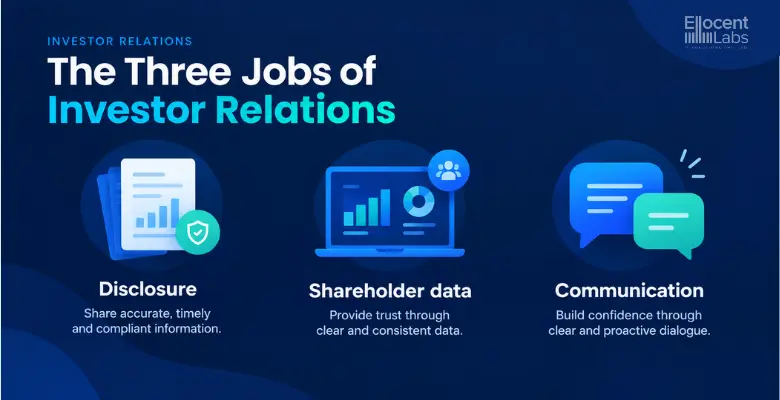
Strip it down and there are three jobs, each with different risks:
- Disclosure. Getting announcements drafted, approved and lodged with the market on time, and in the right order.
- Shareholder data. Knowing who holds what, tracking movements, and handling it as the personal information it is.
- Communication and reporting. Results, investor updates, meeting material and the mail-outs that go with them, usually all landing in the same few weeks.
Most off-the-shelf tools do one of these well. The trouble starts where they meet, because the rules attach to the whole chain, not to a single screen.
What do the ASX rules ask of your software?
Software does not make a company compliant, and this is not legal advice. Your company secretary and your lawyers own the interpretation. What software can do is make the right behaviour the easy behaviour. These are the points that shaped our design:
- Continuous disclosure. Under ASX Listing Rule 3.1, once a company becomes aware of information a reasonable person would expect to have a material effect on the price or value of its securities, it must tell ASX immediately, subject to limited exceptions. Section 674 of the Corporations Act gives that obligation legal force. ASX's Guidance Note 8 explains how it applies in practice.
- ASX goes first. Announcements are lodged through the Market Announcements Platform, and the release must be acknowledged by ASX before it goes to anyone else. Guidance Note 14 covers the detail. In software terms, nothing may leave the building by another route before that point.
- Someone has to answer the audit question. Who wrote it, who approved it, what changed, and when? If the answer lives in an email thread, you have a problem.
- Shareholder data is personal information. The Privacy Act and the Australian Privacy Principles apply to it.
Read the current wording of the guidance notes yourself before relying on any summary, ours included. They are updated from time to time.
What one fact shaped the whole architecture?
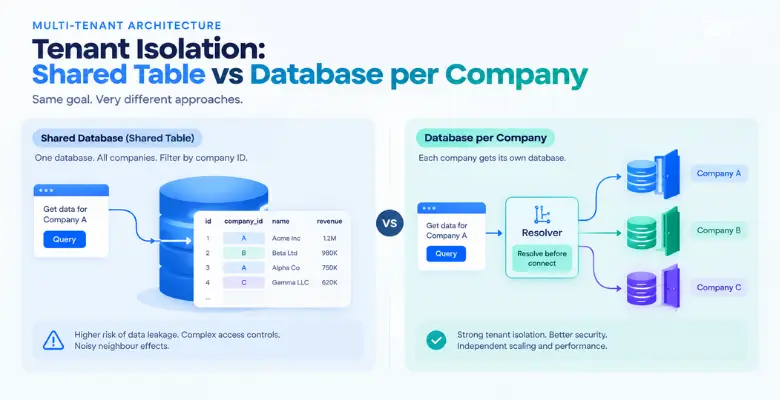
Every listed company is its own legal entity, with its own disclosure history, its own registry relationship and its own exposure if data leaks sideways. So the platform treats each company as a hard boundary, not as a filter on a shared table. Almost every later decision follows from that. The full build is described in our investor relations for ASX case study.
Why give every company its own database?
The usual shortcut in multi-tenant software is one database with a company ID on every row. It is cheaper and quicker to build. It also means that one missing filter in one query can show a company's shareholder register to someone else. We went the other way: one database per client, and no company ever shares a database with another.
The application works out which company a request belongs to before it opens any connection. We call that resolve-before-connect. There is no moment when running code holds a connection that could see the wrong data.
It is not free. There are more databases to migrate, back up and monitor. Connection pooling needs real thought so that many tenants do not exhaust the available connections. And you need per-tenant limits, so one company's busy week cannot starve the others. We accepted all of that. For this kind of data, isolation is worth more than the operational effort it costs.
How do you handle reporting season, when every company is busy at once?
Reporting season is a shared peak. Every client wants the same things in the same fortnight: results announcements, shareholder updates, big mail-outs. A platform sized for the average week struggles in exactly the weeks that matter most.
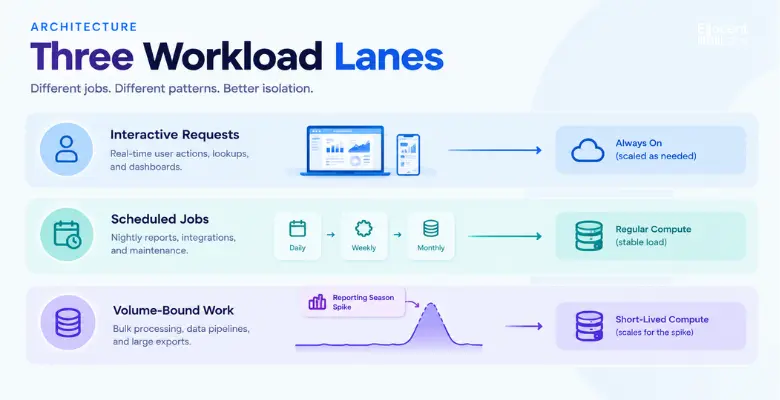
We split the work into three lanes so they cannot get in each other's way:
- Interactive requests, meaning people using the application, which must stay quick.
- Scheduled jobs, about twenty of them: data syncs, reports, reminders and housekeeping.
- Volume-bound work, such as bulk sends and large data processing, which runs on short-lived compute that starts for the job and goes away afterwards.
Two smaller details matter more than they sound. Links in outgoing messages are cached, so a burst of clicks after a mail-out does not land on the application. And delivery is confirmed against the email provider's own record, not assumed from our own send log. If you want to see how we think about elastic infrastructure, our cloud application page covers it.
How do you stop AI putting the wrong thing in front of the market?
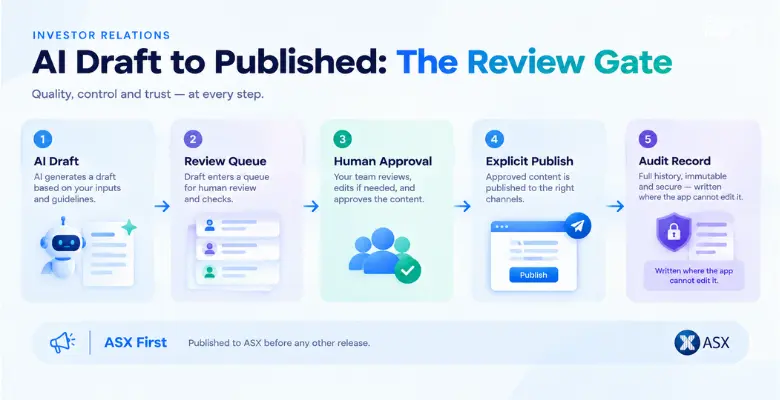
By limiting what it is allowed to do. The platform uses AI to draft, and drafts only. Each draft is grounded in that company's own announcement history, so the wording, terminology and tone match what the company has said before, and it never draws on another company's material.
Then comes the gate. Every draft goes into a review queue, and a person has to approve it. Publishing is explicit (somebody clicks it), atomic (it completes or it does not), and reversible on the platform side. Once something is lodged with the market, nobody can recall it, which is exactly why the gate sits in front of that point and not after it.
Every step writes an audit record to a place the application itself cannot revise. So when someone asks who approved an announcement and when, the answer is not something an administrator or a bug can quietly change. That is the part we would insist on if we were the buyer.
This is the same discipline we apply to our own work: see our engineering practices page, and our thoughts on scaling AI in enterprises from prototype to production. If you are weighing up an AI build of your own, start with our AI development service.
How do you cope with three different registry providers?
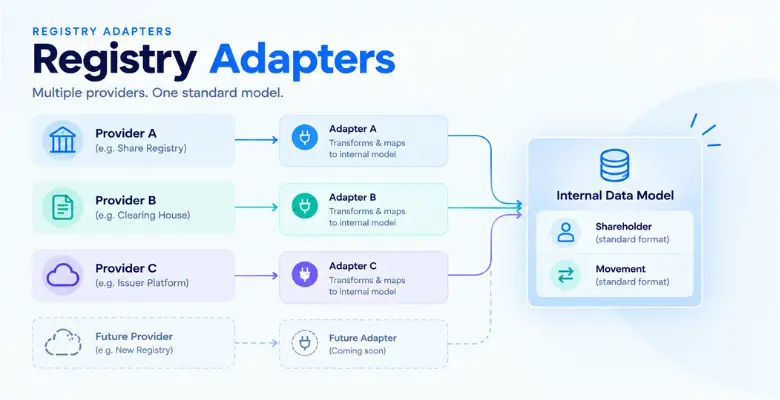
The platform talks to three registry providers, and each has its own formats, schedules and quirks. We put each one behind an adapter that translates into a single internal shape. The rest of the platform then has one idea of what a shareholder and a movement look like, and does not care which registry the data came from. Adding another provider should mean writing another adapter, not reworking the platform.
What do the numbers look like?
| Measure | Figure |
|---|---|
| Modules in one codebase | 26 |
| External integrations | 22 |
| Databases per client | 1 |
| Companies sharing a database | 0 |
| Scheduled jobs | About 20 |
| Registry providers behind adapters | 3 |
Should you build custom software or buy for investor relations?
Buy if a product already fits and your volume is modest. If you are a small-cap with a handful of announcements a year, a packaged tool is probably the sensible answer, and we would tell you so.
Build, or commission a purpose-built platform, when your workflows are specific, when you need integrations no vendor will build, or when data isolation and audit are requirements rather than features. "Custom software" can mean a one-off bespoke system or a purpose-built platform. Ours was the second, which is why we think about it in product terms: see our SaaS development and SaaS onboarding work. If your interest is wider than investor relations, our fintech and capital markets page is the place to start.
What should you ask any investor relations software vendor?
Use these in your next demo. They apply to us as much as anyone.
- Where does our data live, and is it in a database shared with other companies?
- How do you stop an announcement reaching anyone before ASX has acknowledged it?
- Who can publish, and can one person publish alone?
- Show me the audit trail for one announcement. Can an administrator edit it?
- If AI is involved, what exactly does it see, and can it ever see another company's data?
- What happens on results day when every client is busy? Show me how you handle peak load.
- Which registry providers do you integrate with, and what happens when one changes its format?
- How do you confirm a message was actually delivered?
- What is the exit plan? Can we export all our data in a usable form?
- Can we speak to a current ASX-listed client?
What do we not claim?
Two things. First, software does not make a company compliant; your people and processes do. The platform makes the safe path the easy one, and that is all. Second, the platform was designed against the SOC 2 criteria, but we do not hold a SOC 2 attestation, and we will not let anyone assume otherwise. If your procurement needs one, ask us what getting there would involve. Our cybersecurity team can walk you through it.
Frequently asked questions
Can software automate ASX announcements?
It can automate the drafting, formatting, routing for approval and record-keeping around an announcement. It should not remove the human decision to release. Information must reach ASX first and be acknowledged before it goes anywhere else, so the final step should stay a deliberate, reviewed action.
What is continuous disclosure for ASX-listed companies?
Under ASX Listing Rule 3.1, a listed entity must tell ASX immediately once it becomes aware of information that a reasonable person would expect to have a material effect on the price or value of its securities, subject to limited exceptions. Section 674 of the Corporations Act gives the obligation legal force. Check your own position with your lawyers.
Is AI safe to use for investor relations?
It can be, if it only drafts. Keep it away from the publish button, ground it in the company's own past announcements, never let it see another company's data, and keep a human review and an audit trail on every output.
Why use a separate database for each listed company?
It makes a cross-company data leak structurally hard, instead of relying on every query being written correctly. It costs more to run and migrate, so it suits sensitive data such as shareholder registers.
Do you need SOC 2 for investor relations software?
As far as we know it is not an ASX requirement, but many boards and procurement teams ask for it as evidence of security controls. Ask any vendor whether they hold an attestation or are only designed against the criteria, and get the answer in writing.
How long does it take to build an investor relations platform?
Scope decides it. A platform with 26 modules and 22 integrations is a long build, while a focused first release covering announcements, review and audit is much smaller. We would start with the slice that carries the most risk and grow from there.
Want to see how it works in practice?
We can arrange a reference call with a client's team, so you hear it from the people who use it. Ask for that when you book a discovery call, or read about how we work with clients first.
Not sure which approach is right for your project?
We've built both. We'll tell you honestly which one fits.
From no-code MVPs validated in 6 weeks to enterprise AI platforms with 50,000+ users, we've built across the whole range. Book a consultation and we'll tell you honestly which approach fits your budget, your timeline, and your scale ambitions.
Book a discovery call